
PALM LINE TRAINING SCHEMES
History
There is a lot of confusion regarding the title of ‘Cadet’ and ‘Apprentice’ within the maritime industry. However as far as Palm Line was concerned the two terms were effectively interchangeable. Research on the two words indicates that technically Cadets spend most of their time in education with less in practical work and the reverse being true for Apprentices. However, in Palm Line those training to be a Deck Officer, usually referred to as Deck Cadets, spent more time at sea than in college. For those training to be an Engineer Officer, usually referred to as Engineer Apprentices, they spent three of their four and a half years in training in college.
From its inception, Palm line took on and employed Deck Cadets to ensure a supply of suitable and qualified Deck Officers. It had always been accepted that the run to and from West Africa was not the most glamorous and it was going to take a special kind of person to put up with the rigours of the job including the workload, heat, humidity and the general chaos encountered on the West Coast and up the Niger River creeks and Congo River. Whilst covering the costs of the Cadets for their college training was not cheap, their salaries were low and, in many respects, they were also useful members of the crew although they could occasionally could be used as cheap labour.
In the early days of the company recruitment of young Engineer Officers was not a problem as there were plenty of shipyard engineers, who had served a suitable apprenticeship, available. As employment in the Merchant Navy gave an exemption to National Service, many aspiring engineers took the opportunity to take relatively well-paid work and see the world rather than spend time in an unfriendly barracks. However, once the requirement for National Service was dispensed with and the number of British shipyards started to reduce, availability of suitable engineers started to become more difficult. This problem was added to by the fact that many of the Engineer Officers then at sea, extremely experienced though they may have been, were finding it difficult to pass the increasingly onerous examinations to gain the Second and First-Class Certificates. These certificates were needed to be qualified for the Chief and Second Engineer positions on board a foreign going ship. As these positions had to be filled before a ship could put to sea the problem had to be addressed. An Engineer Apprentice scheme was introduced in the early 1960s to deal with the issue.
Historically the positions of Purser and Chief Steward were quite separate and the route to achieving either position was quite different. Pursers were regarded as ‘Officers’ and although Chief Stewards were regarded as ‘Senior Petty Officers’ in most shipping companies, in Palm Line they were also regarded as ‘Officers’. Pursers under training usually started their employment at sea as ‘Writers’, graduating to ‘Assistant Purser’ before their final promotion to ‘Purser’. Chief Stewards usually started as ‘Cooks’ or ‘Stewards’ before promotion to ‘Second Steward’ and then ‘Chief Steward’. In the late 1960s, as a cost cutting exercise, many shipping companies, including Palm Line, started to consolidate the two positions. Initially, this was done by employing both ranks on a ship and the individuals effectively learning and doing each other’s jobs. The time came, however, when a training scheme was found necessary to fill the position of Purser/Catering Officer.
Deck Officer Scheme
During its existence between 1949 and 1987 Palm Line employed well over 100 Deck Cadets, the large majority of whom completed their training and went on to become a Deck Officer. Additionally, some Cadets were trained for the newly emerging Nigerian National Line in the 1960s and 1970s.
On completion of their cadetship the trainees were usually promoted to the rank of Third Officer if they had gained their Second Mate’s Certificate. However, in the earlier days it might be to Fourth Officer, especially if by that stage they did not have the Certificate. There is no question that the company’s standard run to West Africa was not as glamorous or exciting as other Companies’ runs to perhaps Australia and New Zealand and this seriously affected retention rates for those completing their training. This was especially the case in the early years when there were plenty of opportunities elsewhere. By the 1980’s those opportunities were rapidly diminishing and the retention rates increased. Unfortunately, by this stage the size of the fleet was on a constant downward spiral and the redundancies started.
The scheme itself remained broadly similar over the years although the training establishments and colleges used changed. Also, the time spent on each ‘phase’ of the cadetship varied greatly. The length of the training was reduced if the Cadet had been to a sea training establishment prior to employment. There were a number of these training schools including HMS Worcester and HMS Conway both of which were attended by future employees of Palm Line. The basic format was for the newly employed Cadet to attend a college for pre-sea training first. The length of time for this depended on whether the cadet had attended a suitable sea-school before employment. Following this the cadet went to sea for anything from 12 to 18 months. Somewhere near the middle of the cadetship, they then attended a college for theoretical studies aimed mainly at being prepared for the Second Mates Certificate. They then returned to sea for the remainder of their training before finally attending college once again.
As Palm Line did not carry an assigned training officer, as would be found on a dedicated training ship, the onboard training was under the supervision of the Chief Officer assisted by the other two deck officers.
A typical cadet’s day would be on one of the navigational watches when in European waters, usually as a lookout, but also learning navigational skills and the responsibilities required under the Collision Regulations.
When Southbound and south of Cape Finisterre, cadets would more often be on day work learning all aspects of ship husbandry and the care and maintenance of cargo gear.
Sundays at sea were usually designated as ‘study days’ to complete correspondence courses, their Record Book as set by the MNTB and the Company’s Navigating Cadet’s Journal.
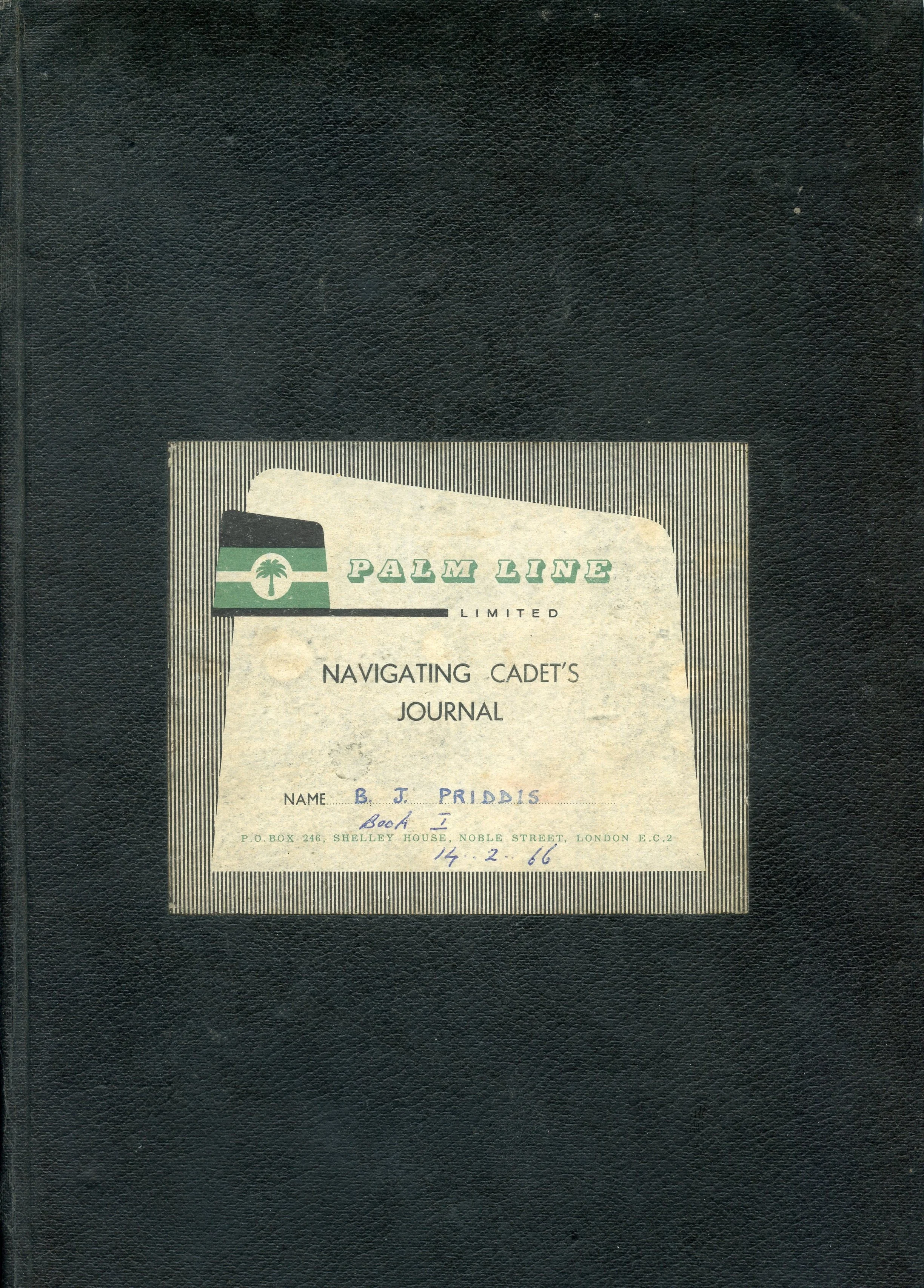
Navigating Cadet’s Journal. Courtesy of B. J. Priddis.
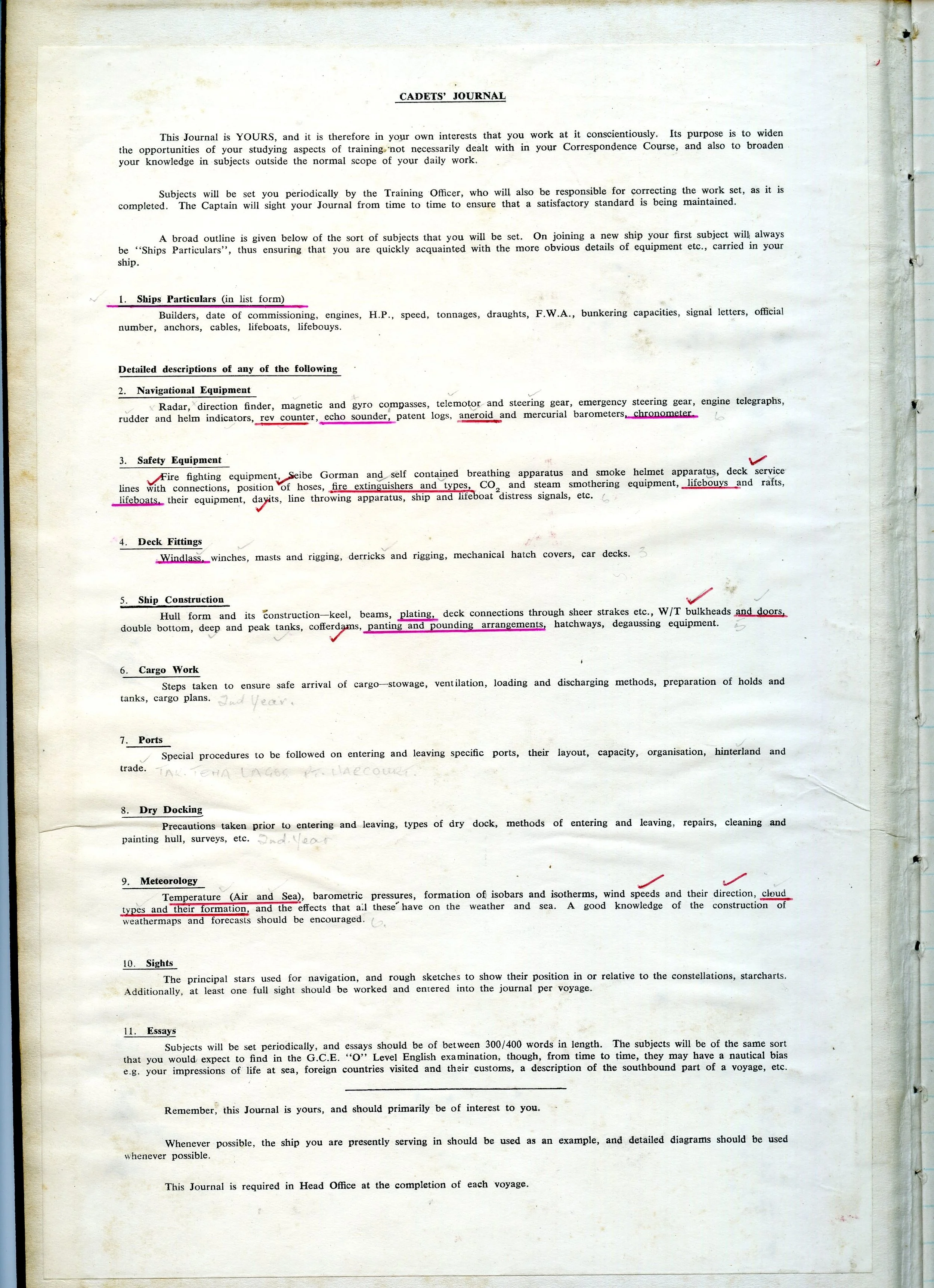
Navigating Cadet’s Journal Courtesy of B. J. Priddis
Engineer Officer Scheme
Palm Line also employed over 100 Engineer Apprentices over its lifespan. Their training schedule did not vary so much as with the Deck Cadets although in the later years it was reduced in length from four and a half to four years. The training consisted of four phases. The first was two years in college (initially Birkenhead Technical College was used and from 1970 Riversdale College in Liverpool) studying for either an OND or ONC in Marine Engineering. As well as the theoretical subjects there were practical courses during the summer holidays in a number of skills including welding. In later years the ONC scheme was replaced by the BTech scheme.
The OND course allowed the apprentices to be exempt from sitting Part A of both the Second and First-Class Certificates and this was a big bonus.
The second phase was a year at sea on one of the company’s ships. The apprentices usually spent this time watch-keeping assisting one of the three engineers in charge of the 12 – 4, 4 – 8 and 8 – 12 watches. When the vessel was in port, the apprentices worked with the engineers on routine maintenance work. Apprentices also had to complete a correspondence course during this time and time for this was usually allowed on Sundays when the vessel was in port.
The third phase was another year back in college, initially Poplar Technical College and then Riversdale. Half the time was spent on theoretical studies, Naval Architecture and Electrical Engineering, and the other half on practical work on engines, pumps and other machinery found in engine rooms in specially outfitted college workshops. The Naval Architecture and Electro-Technology endorsements to the OND gained at this time gave exemption to those subjects in the Part B of the both the Second and First-Class Certificates, another big bonus.
For those in the earlier days on the four and a half year course, the final six months were again spent back at sea.
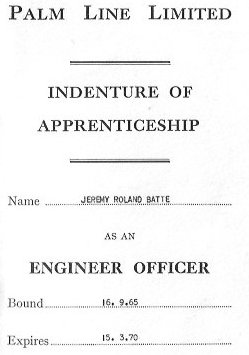
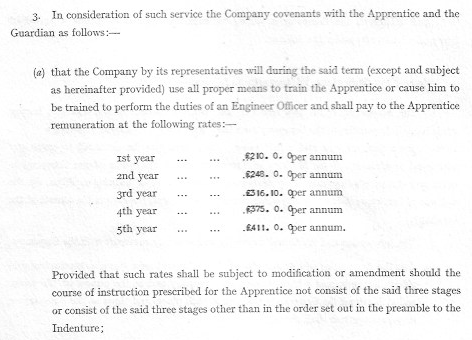
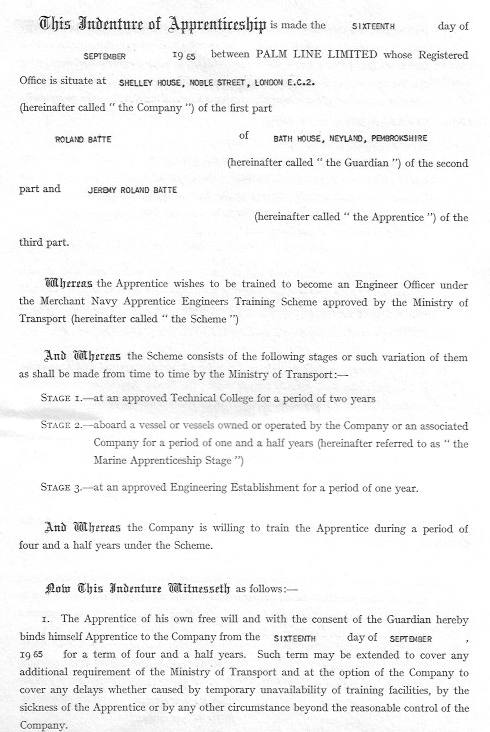
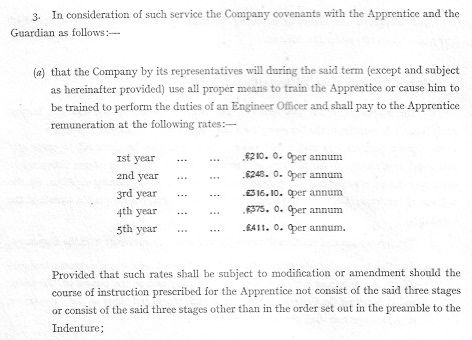
An example of the front page of the formal ‘Indenture of Apprenticeship’ is shown below followed by the pay scales at the time.
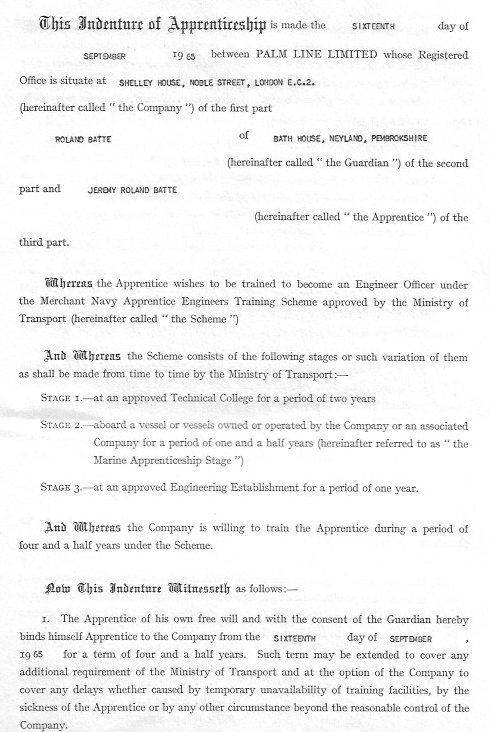
On completion of their apprenticeship the apprentices were appointed as ‘Junior’ or ‘5th Engineers’. In the earlier days promotion after this could be relatively rapid, especially so if the employee gained their Second and First Class Certificates. However, once again in the final years, promotion was slowed by the reduction in the fleet size.
Retention rates for Engineer Apprentices was also relatively low, especially so in the early years, as there were so many other companies looking to employ them on more glamorous ships with exciting ports of call as well as good opportunities for employment ashore. Only one Apprentice eventually made it to the position of Chief Engineer, the author of this article, and that only came about as a result of special circumstances. However, as with the Deck Cadets, there is no question that many of the Apprentices employed towards the end of the life of the company would have made it to Chief Engineer if the company had remained in business.
Purser Catering Officer Training Scheme
A structured and formal training scheme for the position of Purser/Catering Officer was devised by Alan Coubrough, a PCO seconded to the company’s Head Office for the purpose, under the supervision of John Drewery, the Catering Superintendent and Purchasing Manager in 1973. Most candidates started as ‘Trainee PCO’, followed by ‘Assistant PCO’ before attaining the position of ‘Purser Catering Officer’.
Somewhat extraordinarily, 48 trainees were taken on in a five-years period between 1973 and 1978 for a fleet that admittedly did increase from 12 to 13 ships. However, two years late the fleet had rapidly reduced to just 7 ships and then all the ships were sold off one by one until the company was sold six years later. It is perhaps surprising therefore that 7 of the 48 taken on made it to achieving the position of PCO with the company. What is certain is that many of the trainees were more interested in the catering side of the work and certainly did not appreciate or enjoy being used as Tally Clerks in the ships’ holds in West Africa.
Much of the training was ‘on the job’ under the supervision of the on-board PCO. Amongst the many duties to be covered and learnt were the Customs Port Entry Papers, the Catering Providore Book and Crew Documents. In most cases there were two six weeks spell in college, such as the Liverpool Maritime College and subjects covered included the Ship Captain’s Medical Guide as well as a catering course.
Why did they choose to go to sea and opt for Palm Line?
Prior to writing this section the author contacted twenty-four seafarers who had gone through one of the above training schemes with Palm Line to check for accuracy of what he had penned as well as getting additional information. The following questions were included and a sample of the answers are listed below:
1. At what age did you decide on wanting a sea-going career?
Many from the age of 11, some later.
2. Where did you get any advice from regarding this?
Most had little advice from their schools.
Some got advice from family members.
3. How did you hear of Palm Line?
Through the British Shipping Federation and family members
4. Why did you then choose to apply to Palm Line?
Talking to Rod Wilson, the Palm Line Personnel Manager responsible for Cadets.
Advice from family.
They offered a job!
6. At your interview, did you have to take any tests?
Only a handful had to take any form of test.
11. Did you ever act as a sole Watchkeeper, (either officially or unofficially) during that time?
About a third answered yes but it was always unofficial.
14. If there were any individual seafarers who played a positive part in your apprenticeship would be prepared to name them?
Numerous names were mentioned with the following listed more then once:
Tommy Parkin
George Redford
Ian MacLean
Bob Donaldson
Mike Hurley
Alistair Gillone
Bob Stenhouse
George Morris
John Phipps
Sam Smith
Bob Ellsmoor
Jammy Mathews
Andy Hogan
Mike Jennings
Al Coppin
Ken Caldwell
John Woollam
What happened to the trainees after leaving Palm Line?
Palm Line was not the only company to disappear in the 1980s and several more went in the 1990s. Indeed, in the last twenty-five years the majority of British Shipping companies were sold off with the only the ferry companies surviving. Finally, some of those British ferry companies went over to using foreign nationals as well.
The reduction of the Palm line Fleet and the eventual closure of the company in 1987 meant their seafarers had to seek employment elsewhere and unfortunately good seafaring opportunities were scarce. A few of the deck officers did get employment on the ferries and most of those then remained at sea until they retired. A few went foreign flag for a while but the working conditions and relatively low pay resulted in most of them eventually seeking shore-based employment.
The wide variety of positions eventually held by the former trainees is indicated in the list below:
Chief Examiner at GCSE for the NEAB and AQA Examination Boards
Watch Manager (Search Mission Co-ordinator) at HMCG
Master (P&O Ferries)
Master & Offshore Installation Manager (Transocean)
Senior Principal Surveyor (Lloyd’s Register)
Chief Executive Salvage Association
Mayor of Dumfries
Mental Health Nursing
Police Officer
Chairman Carmet Tug Company
HM Prison Service Governor
Shift Engineer in a chocolate factory
Assistant Dock Master (ABP Goole)
to name just a few.