
Palm Line 1949 - 1985
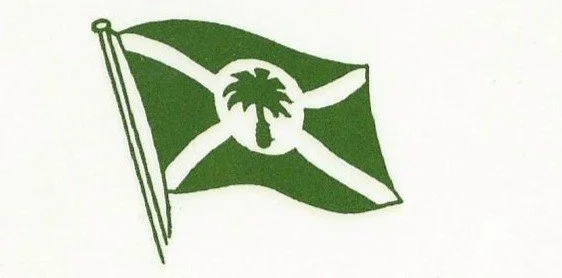
An extraordinary board meeting of the United Africa Company was held on the 16th February 1949. As a result of the political and economic upheaval inflicted on the entire world because of World War two, it was no longer viable to operate the company’s ships as an in-house operation. The decision was made to make the shipping side of the business a standalone company, a common carrier able to go about business in the same way that the other shipping lines did and not being wholly tied to United Africa Company cargoes. To fulfil this the Articles of Association of the old Lever business, the Southern Whaling & Sealing Company, were revived and a new name attached. There was, apparently, some considerable discussion as to the new name of the company. The Sun Line was one of the suggestions, however, this was dismissed and the name Palm Line decided upon. With reference to one of the main commodities that Lever used within the business, further discussions around the company emblem eventually led to agreement on the Palm tree. Despite the reservations held by some board members, both the emblem and the company name proved to be successful and highly respected in the long term. On the company’s formation the first board of directors consisted of Mr. Frank Samuel, who was appointed chairman (He later became chairman of UAC), Mr. George Cole (later Lord Cole, chairman of Unilever), Mr. Arthur Smith (later Sir Arthur Smith, chairman of UAC), Mr. Thomas Bragg and Mr. A.E. Hoffman.
When the Palm Line came into being, the company inherited 15 ships from UAC, 13 dry cargo and 2 vegetable oil carriers. These comprised 3 motor ships and 4 steamers, built pre-war, 3 steamers built during the war and 5 post war-built steamers. On the 9th May 1949 eleven ships were renamed with Lloyd’s Register of Shipping, the remaining ships were renamed on the 10th and 12th May respectively. The first ship to appear in the new livery was Oguta Palm (ex Lafian ‘49) built in 1943. A third of the fleet was under four years old and the oldest ships were thirteen years old. On 1st January 1950, Palm Line was admitted to the West Africa Lines Conference (WALCON), joining the existing members including Elder Dempster Line, the Guinea Gulf Line and the Holland West Africa Line.
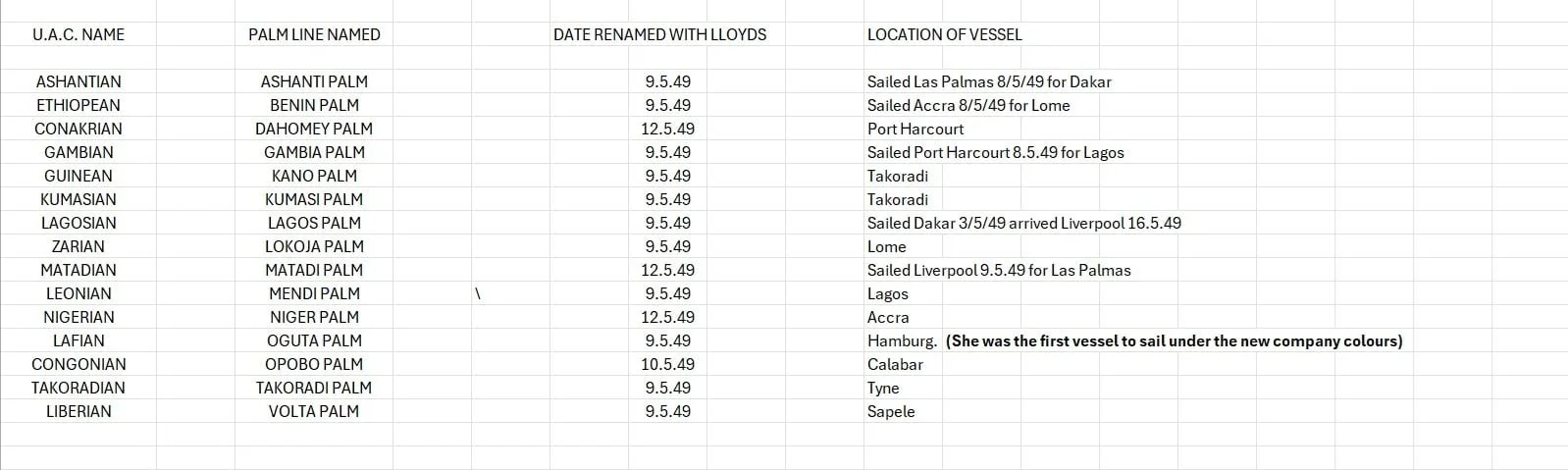
Information courtesy of Alan Weekes
Even with a relatively young fleet, it was decided that to stay ahead of the competition an ambitious building plan was required. The prediction of a rapid expansion in the West African trade proved to be correct. As a result, new tonnage was needed. The geography of the West African coast has always, to some extent, dictated aspects of the design of the ships trading there. The next generation of Palm Line ships were all, except for the Kano Palm (II) and the Katsina Palm, under 500 feet long. This was so that they could navigate the Nigerian creek system. Draught was also a limiting factor. At one point in time 17 feet draught, and a capacity of 4000 tons of cargo were the maximum limits when crossing the Escravos Bar when heading up to the creek ports.
With all this in mind orders for four ships were placed, two in the UK with Short Brothers in Sunderland and two in West Germany with A.G. Weser, Bremerhaven. The Wear built ships, Burutu Palm (1952) and Africa Palm (1953) were delivered late. The builders blamed their steel suppliers, saying that they had only received five sixths of the steel that they required. It isn’t clear whether the excuse was believed, the consequence though was that Palm Line did not order another ship from the River Wear for another 25 years. Instead, when looking for someone to construct their ships they went to the Tyne and built a firm working relationship with Swan, Hunter and Wigham Richardson Ltd.
The two ships that were built in Germany were acquired for the subsidiary Ölhandel-und Transport-Gellshaft GmbH of Hamburg. They were steam ships and traded under the German flag and had German crews, Sapele Palm (1953) and a bulk vegetable oil tanker, Tema Palm (1953). The arrival of these two ships in the fleet meant that two of the older pre-war German built ships could be sold. Therefore, in 1954, the Kano Palm (I) and the Volta Palm, both of 1936 vintage, went on for further trading.
In 1954 the directors went on another shopping trip. Their list this time was for fourteen new vessels. Orders for twelve ships for delivery between 1956 and 1961 were placed with Swan, Hunter and Wigham Richardson Ltd., to be built on the River Tyne at their Neptune yard. A trip across the North Sea provided contracts to build two additional ships at a German yard. The Akassa Palm (1958) and the Andoni Palm (1958) were products of Bremer Vulkan, Vegesack. They were not to be the last German built ships that Palm Line would own, however, they were the last that they had built on their own account.
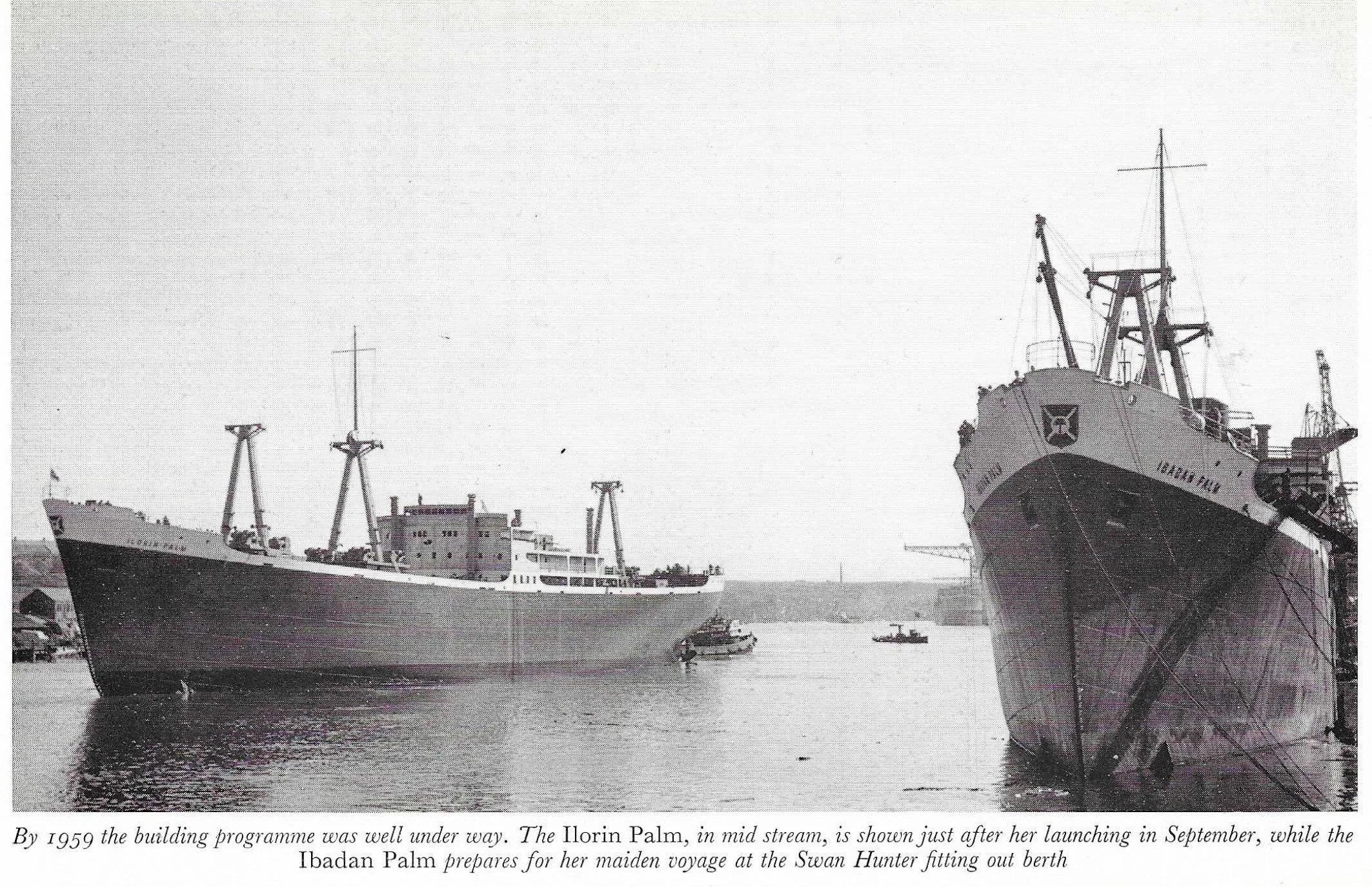
1956 saw the first pair of ships delivered. The Bamenda Palm (I) entered the water on the 14th December 1955 and the Badagry Palm (I), launched on 11th June 1956, and completed in March and October respectively. Not a company to shy away from practical innovation and a way of making their ships more profitable, the Elmina Palm was the first British built and British owned ship to have her superstructure, funnel and lifeboats constructed of aluminium alloy. The weight saving was 74 tons. This was carried on in other buildings too. So, during 1957 the Elmina Palm and the Katsina Palm joined the fleet. Their sisters Enugu Palm and Kano Palm (II) arrived in 1958, a busy year as the Akassa Palm and the Andoni Palm both also were accepted into the trade as well. The “K” twins weren’t designed for working the creeks, at 8,700 gross tons apiece they were thought to be too big. In subsequent years however they did venture into the river system, with the Kano Palm (II) being recorded as visiting Sapele at least twice. This left six ships still to be delivered. Between 1959 and 1961 the company received the Ibadan Palm in 1959, the Ilorin Palm and the Lobito Palm in 1960 and the last trio in 1961, the Ikeja Palm, Lagos Palm (II) and the Ilesha Palm.
In 1960 both German ships, the Sapele Palm, which kept its name, and the Tema Palm, which became the Makurdi Palm, were transferred to the British flag and registry. The bulk palm oil trade had been consistently good during the year, a decision was taken to acquire another ship to supplement the tanker fleet. There wasn’t time to have one constructed, so a suitable candidate was sourced. The British Rover (1951) was bought from the B.P. Tanker Co. Ltd. and became the Makeni Palm. As the new ships took their places in the trade older vessels left the fleet. In 1959 five ships went on to new owners. The Benin Palm, Gambia Palm, Takoradi Palm, Mendi Palm and the Dahomey Palm, all found new homes. 1960 saw two more leave, Oguta Palm (I) and Kumasi Palm sailed on for their new owners. Sadly though, the Oguta Palm (I), as the Aristotles only managed another two years. She developed a leak and sank in Mid-Atlantic in December 1962 whilst on voyage from Detroit to Calcutta. (See also Losses and Accidents section). With the sale of the Oguta Palm (I), the Lagos Palm (I) became Oguta Palm (II) to free the name for the new building. Another departure, this time in 1961, was the Opobo Palm, she traded on until 1963 when she went to the breakers yard. 1961 saw the conclusion of the building programme. The company could now concentrate on the business of transporting goods to and from West Africa, utilising the most modern fleet in the trade.
The only peacetime loss that Palm Line suffered was in November 1962. A detailed account of the incident can be read in the Losses and Accidents section. In brief though, the Ashanti Palm was at Naples, she was due to load around 400 tons of cargo. It was during a severe gale that, whilst at anchor outside the harbour, she dragged her anchor and struck the breakwater. Eventually because of deteriorating conditions the Ashanti Palm rolled off the breakwater and sank. The saving grace was that there was no loss of life.
The golden period for the trade really seemed to be between the formation of the company, in 1949, and the early 1960’s. At one point the fleet numbered 23 ships and, anecdotally, there were another 22 vessels chartered in to cover the company’s scheduled voyages. The downturn came owing to factors such as political unrest and civil war in some countries, increasing levels of self-sufficiency. Additionally, the establishment of national shipping lines didn’t help the situation for the UK companies.
With the older ships already having been disposed of, at only 14 years old in 1962, the Matadi Palm (I) was the first of the next ships to be sold. In February 1963, she left the Mersey for the last time and headed to Spain and the breakers yard. Leaving the company in 1964 the Oguta Palm (II) went on to trade for another 9 years before being beached in Yugoslavia and broken up. A hint of what would ultimately happen in the future, one of Palm Line’s competitors didn’t reduce their fleet, they sold it. John Holt’s Guinea Gulf Line passed to Elder Dempster Lines. The identity was retained and seen for a few more years.
The decline carried on, and whilst 1966 saw success for the England football squad, it also saw a further 3 ships leave Palm Line. The Lokoja Palm (I) and the Sapele Palm both went on to trade until 1973, the Niger Palm, however only had another 2 years before she went under the shipbreakers torch, arriving in Hong Kong in 1968. The Burutu Palm and the Makeni Palm both went on to new owners for further trading in 1967. As the Globe Star the BurutuPalm met her end on a reef outside Mombasa, the details are in the Losses and Accidents section. This left the company with only one, ageing, tanker. The Makurdi Palm ex Tema Palm sailed on until 1969, when she too departed for a new owner. As cover for the vegetable oil trade the tanker Saga State was brought in on long term charter.
Here we are at the start of a new decade, and it begins with a new building. The Matadi Palm (II) built on the River Tees at Haverton Hill, launched in July and was completed in December. After several teething problems were sorted, she went on to be a very profitable ship, to some extent covering losses made by other ships in the fleet. Ultimately, she was the last vessel owned. The slowdown had remained steady, as did the number of ships leaving the company. 1972 saw a further four ships move on to new owners. The Africa Palm (I), Bamenda Palm (I), Badagry Palm(I) and the Akassa Palm all found new homes. The fleet now stood at 11 dry cargo ships and 1 tanker.
During the 1960’s, Palm Line along with the other companies within the Conference experimented with containers in an attempt to modernise and improve cargo handling. Speeding up the loading and discharging systems to lessen the time in port was the aim. The adage/mantra from the road transport industry of “If the wheels aren’t turning, they aren’t earning” is no less applicable to ships. Time in port costs. Not only that but there were also other aims, to reduce cargo handling costs, damage and theft. In 1965 African Container Express (ACE) was launched. Palm Line, Elder Dempster Lines and the Nigerian National Shipping Line offered the unique, at the time, “door to door” service from London and Liverpool to Freetown, Lagos and Port Harcourt. The standard container of that time (not what we are all familiar with now) had a payload of 8.75 tons and a gross weight of 10 tons. In 1968 International Organisation for Standards (ISO) along with IMO introduced the standard 20” and 40” containers that everyone recognises today. This all leads to the point when Palm Line dipped its toes into the water and purchased, in 1974, their first container friendly ship. A 3-year-old, German built, Norwegian owned vessel, the Joruna became the Africa Palm (II). The future was here and now, instead of a large number of small ships, the norm was becoming a small number of large, faster ships.
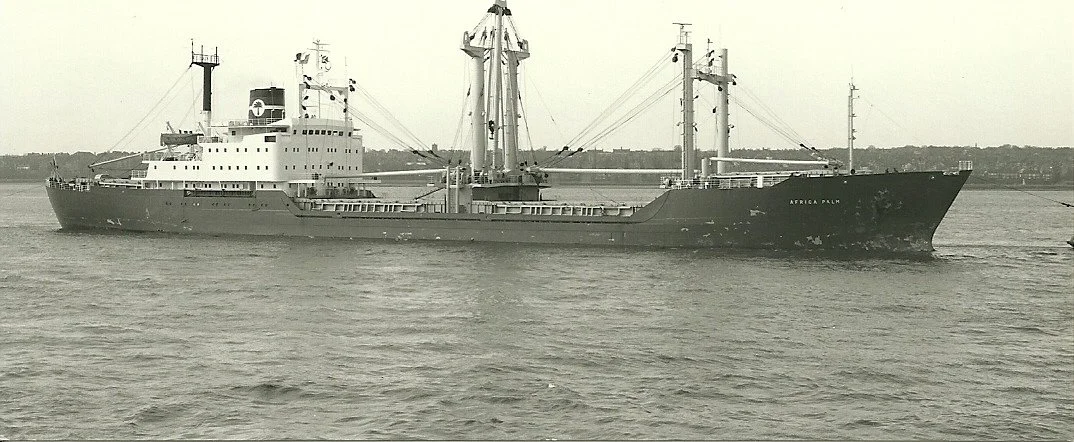
Africa Palm (II) arriving at Liverpool for the first time. © Unknown
The Andoni Palm was the next conventional cargo ship to leave the company service in 1976; she went on to serve her Greek owners as the Mastromanolis for another 6 years before being sold to the shipbreakers. After the Africa Palm (II) proved so successful working in the West African trade, the decision was taken to replace her with a vessel on long term charter. The H. Schuldt of Hamburg owned ship, the Hasselburg, built in 1974, became the first Apapa Palm. She remained German flagged and crewed. Ideally at the end of the charter Palm Line would have liked to purchase the Hasselburg from their owners, however, she was not for sale. The Schauenburg, built in 1973, however, the lead vessel in her class was available and negotiations began on her acquisition. Her last voyage for her German owners was on charter to the Black Star Line (Ghana). Adrian Hobbins signed on as supernumerary to gain familiarisation with the ship. He stayed with her during the voyage and for her River Tyne drydocking prior to entering service as the Apapa Palm (II) in 1977. The Elmina Palm left Palm Line that same year and saw further service until 1981.
The following year saw three more ships sold on for further service Enugu Palm and Ibadan Palm went to the Kuwaiti flag, whilst the Katsina Palm went to owners in Singapore. All three were beached by 1984. Also, in 1978 orders were placed for two new ships, the Bamenda Palm (II) with South Korean builders, Hyundai Heavy Industries in Ulsan. The second was the return to the River Wear 26 years after the last ship (Africa Palm (I)). Sunderland Shipbuilders Ltd were contracted to construct the Badagry Palm (II). Both ships were delivered in 1979. With their entry into service and the continuing fall in the level of cargo being offered, the sale of the conventional ships continued. The Kano Palm (II), Lobito Palm, Ilorin Palm and the Ilesha Palm all found new homes.
Here we are at the start of another new decade, and the Palm Line fleet stands at seven ships. The two last conventional liners, four multi-purpose ships and the lone tanker. It is worth noting that Elder Dempster Lines weren’t fairing any better. At their peak they had somewhere around 60 ships on their books and now they were owners of around 6. Chartering both in and out has been a pattern throughout the Palm Line story. During 1981 both the Ikeja Palm and the Lagos Palm (II) undertook trips across the Atlantic from Nigeria to Brazil. This was only going to occur more often as the years went on. In mid-1980 it was announced that the company would have two ships built at the same yard that constructed the Apapa Palm (II). The first of the Polish built ships was, initially, due towards the end of 1981 and the second in early 1982. In preparation the Lagos Palm (II) was renamed in mid-1981, becoming the Lagos Palm II to release the name and avoid confusion with the new build. The Lagos Palm (III) and the Lokoja Palm (II) joined the fleet in mid and late 1982 respectively.
The Ikeja Palm and the Lagos Palm (II) were the last remaining ships from the ambitious building programme of the 1950’s. The were arguably the most elegant of the ships, with sleek and beautiful lines. The last time they were seen together in the UK was in Tilbury in May 1980. By the time they were sold on for further service, the Ikeja Palm had completed 89 voyages on the company’s behalf. The Lagos Palm (II) completed an admirable 112 voyages, achieved by serving on the 42-day express service from the UK to Apapa. Both ships were chartered out for their final voyages, heading out to the Far East. In the autumn, Ikeja Palm loaded for a single outward voyage with Anchor Line. Her itinerary took her to Aden, Colombo, Karachi and Bombay. The handover to her new owners took place off Piraeus. Both ships had left the fleet in December 1981. Neither had very long career after leaving Palm Line though the Lagos Palm (II), now the City of Lobito did have newsworthy end, being blown ashore and grounding in a typhoon whist at Hong Kong in December 1983.
When they were completed the two new Polish built ships came into Hull. The Lagos Palm (III) in August 1982. She stayed there for a short lay-up, to finish off some fitting out and prepare for her maiden voyage proper. The Lokoja Palm (II) arrived in Hull in December 1982, again for a short lay-up and preparation for her maiden voyage. However, instead of taking up a Palm Line voyage she was chartered out to the Woermann Line of Hamburg. Renamed Wameru, she headed over to the continent to load in Hamburg for West Africa, undertaking 5 voyages for them before repainting her funnel in the company livery and returning to her given name. No sooner had she completed that charter than she was to sail on someone else’s account, this time Hoegh Lines chartered her. The writing truly appeared to be on the wall. The end of 1983 saw the Africa Palm (II) become surplus to requirements and she was sold onto a Cypriot owner and renamed Messaria.
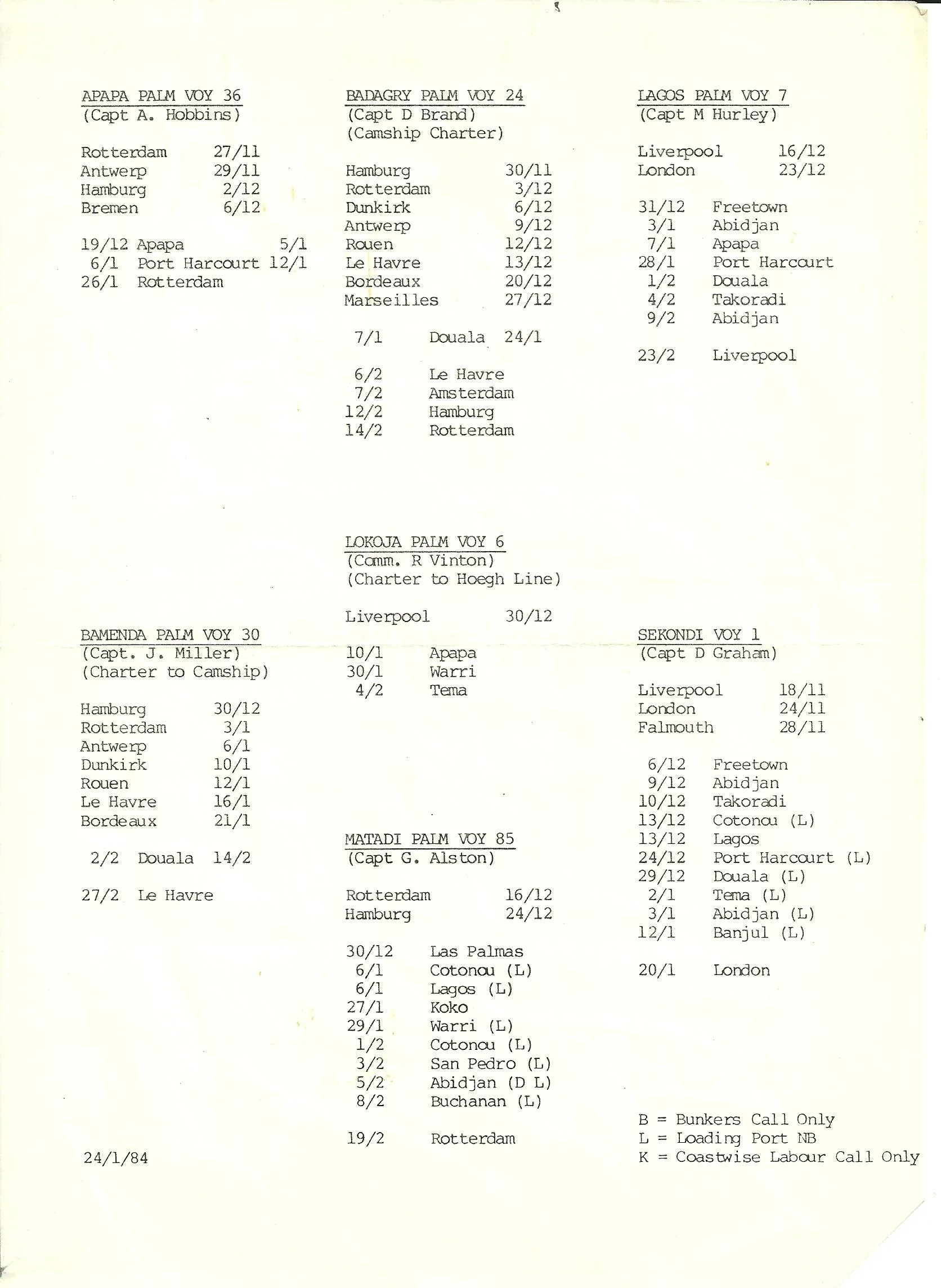
At the beginning of 1984 the situation for the remaining ships wasn’t brilliant. This was only, really, the tip of the iceberg. As the year went on fewer sailings on the UKWAL itinerary were being undertaken by Palm Line ships. (The sailing list below shows the situation in January) The Badagry Palm (II) and the Bamenda Palm (II) were both on charter to Cameroon Shipping Lines. Despite the situation it proved necessary to charter in the Sekondi from Elder Dempsters to cover a sailing. Quietly going about business in the background were the Apapa Palm (II) and the Matadi Palm (II) maintaining sailings. In contrast by the time we get to May the picture is quite a bit different. Both the Lagos Palm (III) and the Lokoja Palm (II) were on charter to the Lloyd Brasileiro Line, trading as the Lloyd Rio and Lloyd Australia respectively. Towards the end of May, the Bamenda Palm (II) entered Middle Docks on the Tyne, at the end of her Camships charter, for her 5-year survey drydocking. In early June, when she emerged from the dock, she had become the Lloyd Texas and joined her sisters. The Matadi Palm (II) could also be found a little off her usual beaten track, with voyage 86 taking her to a few points East and turning around in Bombay for the return. The slow down in trade did not change in 1985. The Apapa Palm (II) was sold to Venezuelan interests and went on to become the General Salom and then, in 1994, the Orient Challenge. This was the name under which she traded until going to the breakers at Alang in August 1999.
This was autumn 1985, the decision had been made by Unilever to divest itself of its shipping interests, as they didn’t fit in with their core business. The deal done, the Palm Line name, the trademark palm tree, trading and conference right were sold to Ocean Transport and Trading. With effect from 22nd October 1985 the Palm line as was known and loved by many of those who had worked for, worked with and had any association with was gone. The ships, however, were not part of the deal. The end of the Lloyd Brasileiro charter saw the Lloyd Australia return to the company, which was now known as UAC International Ltd., and became the Lokoja. Lloyd Rio was renamed Lagos. Badagry Palm (II) and Matadi Palm (II) both lost the Palm suffix and became Badagry and Matadi respectively. The Bamenda Palm (II) had returned from her charter with Lloyd Brasileiro and reverted to her original name. I believe she completed one voyage on Palm Lines account and on her return to the UK she was sold in November 1985, becoming the Arko Glory for Cypriot owners. It was not an auspicious start for her, she was reported as having to be beached in Paradiso Bay near Messina on 24th December, after becoming unstable during the voyage from Hamburg and Naples to East African ports. She was refloated on the 28th December and continued with her trip.
The original plan was for the remaining ships in the fleet to fly the old UAC house flag and the funnels were to be painted buff with a black topping. As the ships were all on the market for sale this didn’t happen. Each ship removed the steel palm trees, and the white discs were painted out, leaving a white stripe around the funnels.
So, here we are at the start of 1986. 5 ships constitute the fleet in what was to be the final year. The story continues in the next part of the history in UAC (again) 1985 – 1986. I hope I have done justice to the Palm Line story.
References: Palm Line: The Coming of Age 1949 – 1970. Roger Kohn.
Palm Line. Laurence Dunn and P.M. Heaton.
Ships in Focus Record 35. Article by Roy Fenton.
Ships in Focus Record 36. Article by John Goble.
Diaries of Captain A.S. Hobbins