
THE LOSSES AND ACCIDENTS
Steel Ships Sink
In the first lecture he gave to the Ship’s Science first year students at Southampton University in 1986, David Cooper, RCNC, scrawled on the blackboard STEEL SHIPS SINK. Although the intent of this message was clear to the author at the time, the reality is quite different. Most steel ships end their lives by being broken up, usually somewhere un-exotic like the Gadani and Alang beaches on the coast of Pakistan and India. The truth is that most of the Palm Line ships ended their lives this way, beached and broken up.
Unfortunately, however, a significant number of the company’s ships were involved in tragic accidents and incidents both during their days with Palm Line and subsequently under different owners. Many of these incidents are described below. They are placed first in alphabetical order by name of the ship and then in chronological order where there was more than one incident on the same ship. The author apologises for any unintended offence that might be the result of mixing the limited number of truly horrific events described with the more mundane incidents somewhat routinely encountered by seafarers.
AFRICA PALM – Fire & total constructive loss
The 1953 built AFRICA PALM, which had been sold by Palm Line in 1972 and renamed SAVOYDEAN, caught fire on 24th July 1975 whilst off Calcutta on a voyage from Chittagong to an undeclared port in Africa. She was declared a total constructive loss and was broken up in 1976.
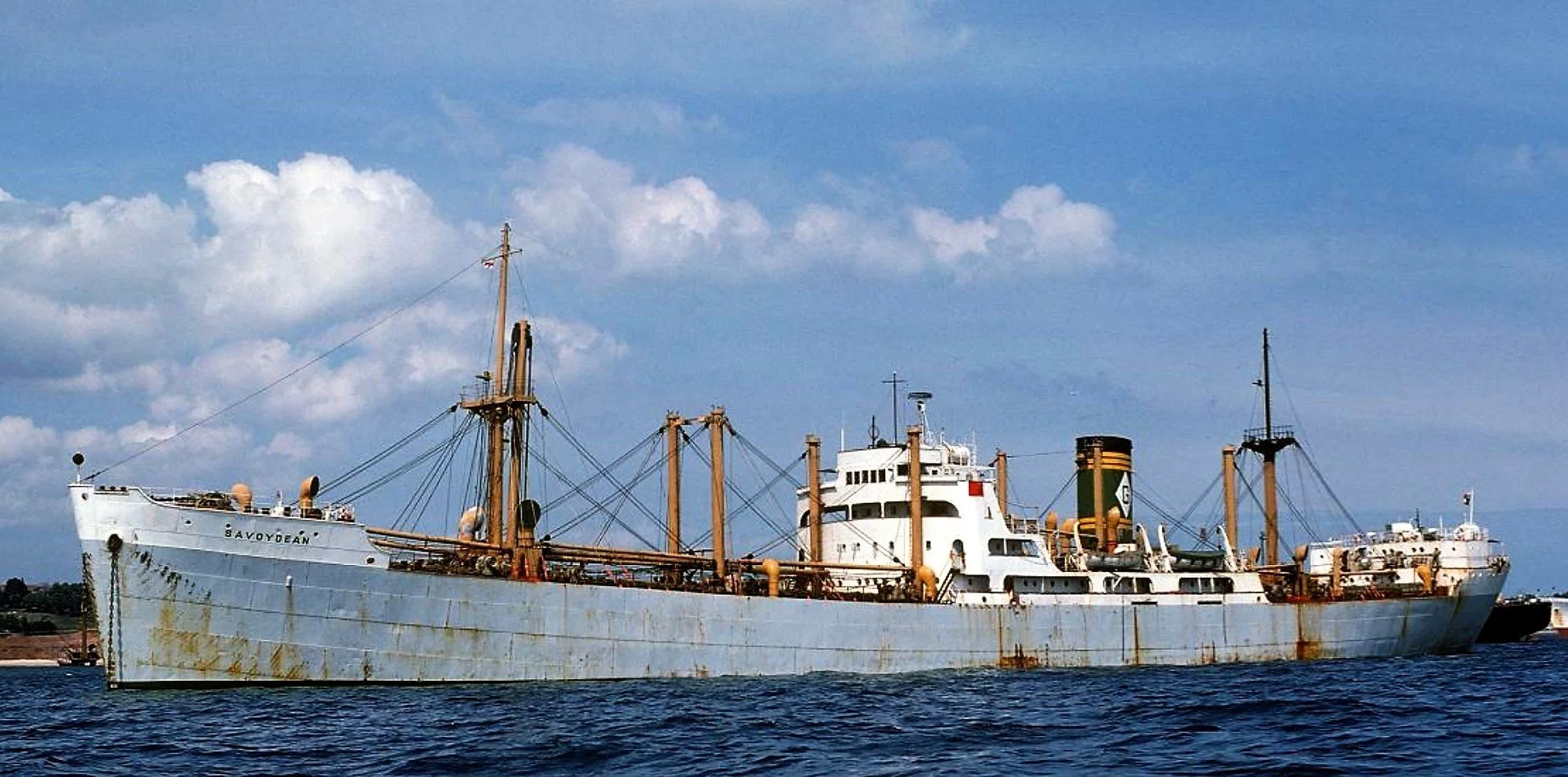
M.V. SAVOYDEAN
AKASSA PALM – Loss of Brian Elvin at sea
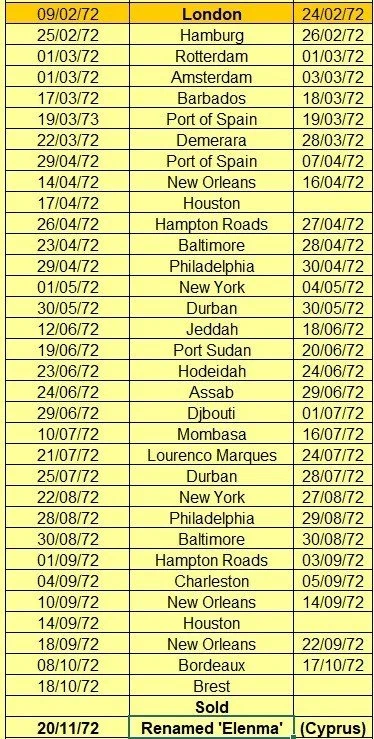
In February 1972 the AKASSA PALM was chartered for a six-weeks voyage to the West Indies and back from North-West Europe. After discharging its cargo in Bridgetown, Barbados, Georgetown, Guyana, and Port of Spain in Trinidad, the return voyage to Europe was cancelled and the vessel was re-chartered to run from ports on the East Coast of the United States, to South Africa, the Red Sea, South Africa again and back to the United States. From there it returned to Europe eight and a half months later with a full cargo of soya bean meal. The vessel was sold in Brest after the cargo had been discharged in Bordeaux.
AKASSA PALM: Voyage Itinerary 9 February to 18 October 1972
Not long after sailing from Durban and heading for Jeddah, the author was halfway through his 8 to 12 o’clock morning watch when, without any warning, the engine room telegraph rang ‘STOP’. The ship almost immediately heeled over violently to starboard.
Aside from stopping the engine, which was relatively simple, there were a number of immediate concerns. The first was to control the main engine temperatures. Too rapid a cooling of the engine results in cylinder liners cracking. Overheating is just as serious. The second immediate problem involved changing over from running the engine on the highly heated heavy oil to the unheated diesel oil. The heavy oil could solidify if there were a prolonged stop. Neither task could be carried out quickly and easily when no warning had been given. Sudden stops like this one were thankfully rare. Plenty of warning is usually given to the engine room before a change in engine movements might be required.
It was assumed the vessel’s heeling was due to the rudder being put hard over, possibly to take evasive action to avoid a collision. However, that seemed somewhat odd because the weather was perfect and visibility excellent.
The ship’s general alarm was then sounded about a minute later and that just added to the confusion. There are no windows in a ship’s engine room. Until someone tells the engineer on watch what’s occurring he would be somewhat in the dark.
The author was still trying to adjust the cooling water, change over to diesel oil, open the main engine compressed air start bottles and start one of the air compressors when other engineers appeared. Simultaneously, the officer on the bridge telephoned with the terse message “There’s a man overboard, we’re going to need the lifeboats”. The Chief Engineer asked the author if he would go in one of them. It wasn’t really a request. He made his way as quickly as possible up to the boat deck after letting the others know what he had done with the machinery and control valves. The telegraph was still showing ‘STOP’.
As the author jumped into the port lifeboat he’d assumed that whomever it was who had fallen over the side was visible and he was going to be picked up. Again, there wasn’t time to dwell on the possibilities as the lifeboat was already being rapidly lowered. There were five in the boat, the Chief Officer, Jimmy Bott, three others and the author. From the boat deck of the ship, which was one level below the bridge, the water had looked relatively calm and there was almost no wind. However, once in the water in a small lifeboat, things were very different and a long swell with a gentle rise and fall of about fifteen feet was experienced. That may not sound much but it does mean you cannot see very far for most of the time when sitting in a lifeboat.
Jimmy explained that Brian Elvin, the ship’s young seventeen-years old Junior Ordinary Seaman had fallen over the side of the ship just forward of the bridge on the starboard side. Apparently, he’d been helping to clear up on top of the deck cargo on the foredeck at No. 3 Hatch. Much of the deck cargo that had been loaded in New York had been discharged in Durban and that meant there was a lot of loose protective material, known as dunnage, on top of what remained.
The AKASSA PALM had crossed the Atlantic Ocean with a mass of deck cargo on board. On top of the No. 3 hatch covers there had been 40-foot containers straddling the hatch coamings. On top of the containers were flat-bed trucks. On top of these were large pick-up trucks and then came the Chevrolet cars. These were almost level with the ship’s bridge at the top of the mid-ship’s accommodation block. For twenty-five days there had been an odd sensation looking forward from the bridge as the Chevrolet cars moved up and down continuously because of their, and the vehicles under them, suspensions.
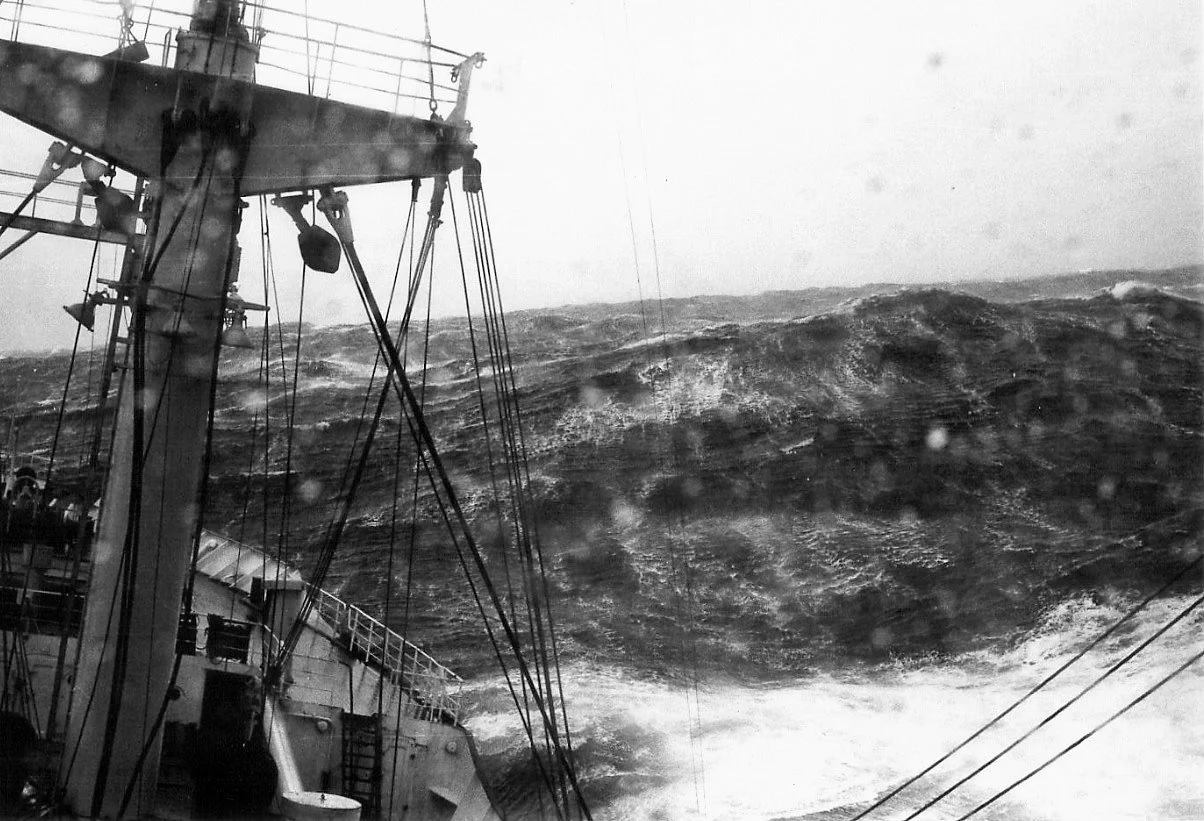
AKASSA PALM: Somewhere, mid-Atlantic, between New York and Durban
For some unknown reason, Jimmy steered the lifeboat around the bow of the ship as that is where he had been told to go, perhaps he must have thought that because the ship’s engine had stopped, the ship was also stopped. Unfortunately, that wasn’t the case. Just as we were rounding the bow of the ship, the lifeboat’s engine cut out. The AKASSA PALM was bearing down on the lifeboat, probably making about four knots. That was more than enough to sit on top of a small lifeboat and sink it. Instinct cut in and on the assumption that there must be a bit of water in the fuel the author managed to clear this and get the engine going again. He was told subsequently that it was less than a minute, but without any question, that was the longest minute he had ever endured. The ship missed the lifeboat by about five feet. How it was not swamped and turned over by the still present bow wave was a miracle.
It was learnt later that Brian Elvin had been throwing broken dunnage over the starboard side of the vessel from the top of the remaining deck cargo. A damaged pallet had fouled something and he had attempted to dislodge it with his foot. The acting Third Officer, Pete Stanley, who was keeping watch on the bridge at the time, saw Brian fall over the side. He immediately took the ship off autopilot and swung the wheel over to hard starboard as he thought this would take the propeller away from the young lad. At the same time, he moved the ship’s telegraph from full ahead to stop. He also released the emergency lifebelt on the bridge wing and shortly after sounded the general alarm. Initially Brian was seen splashing in the water behind the ship. The arrivals on the bridge tried to keep an eye on him with binoculars. Unfortunately, this could not be sustained for long because of the long heavy swell.
The second lifeboat was subsequently launched and some other vessels in the area joined the search, tragically to no avail. Around three o’clock that afternoon some dunnage was found in the water and then a green flip-flop. A similar flip-flop had been found up on the deck cargo. A quick check confirmed that the one picked up was a match. At the same time two large sharks started circling the lifeboat. The lifeboats were returned to the ship and at four o’clock the search was reluctantly called off. Starting the main engine again and bringing it up to full speed after the ‘Full Away’ telegraph signal was given was a difficult moment for those on board.
ANDONI PALM & the Lillobrug Rail Bridge, Antwerp
On 3rd July, 1971, the Andoni Palm, on passage from Hamburg to Antwerp, had just passed through the Northern locks at Postpolderweg and was proceeding up the canal towards the port with tugs fast at both ends. Visibility was extremely poor with thick fog. Barry Priddis, the extra Second Officer, was on the forecastle head with the ship’s Carpenter.
As the vessel proceeded along the canal at very slow speed, it was noticed that the Lillobrug rail bridge was close on the starboard bow, requiring that the ship needed to alter course immediately to port as the distance was rapidly closing.
This was reported to the Master, Captain Eddie Brawn, on the bridge and immediately the forward tug tried to pull the vessel back into clear water. Alas, this was too late and as it became increasingly obvious to both the 2nd mate and the Carpenter that the ship was going to hit the bridge. They both immediately vacated the forecastle to seek shelter at the forward end of No 2 hatch at the break of the forecastle. As Barry Priddis reported, it was the 60 year old Carpenter who made it to the shelter of No 2 hatch before the 23 years old Second Officer!
When the ship collided with the bridge, rivets and bits of steel came down onto the foredeck and the starboard anchor was torn along the starboard side. The resulting damage to the ship is as shown in the pictures below. Rod Dominey, the Second Officer, can be seen in the second image looking out from beneath the forecastle head
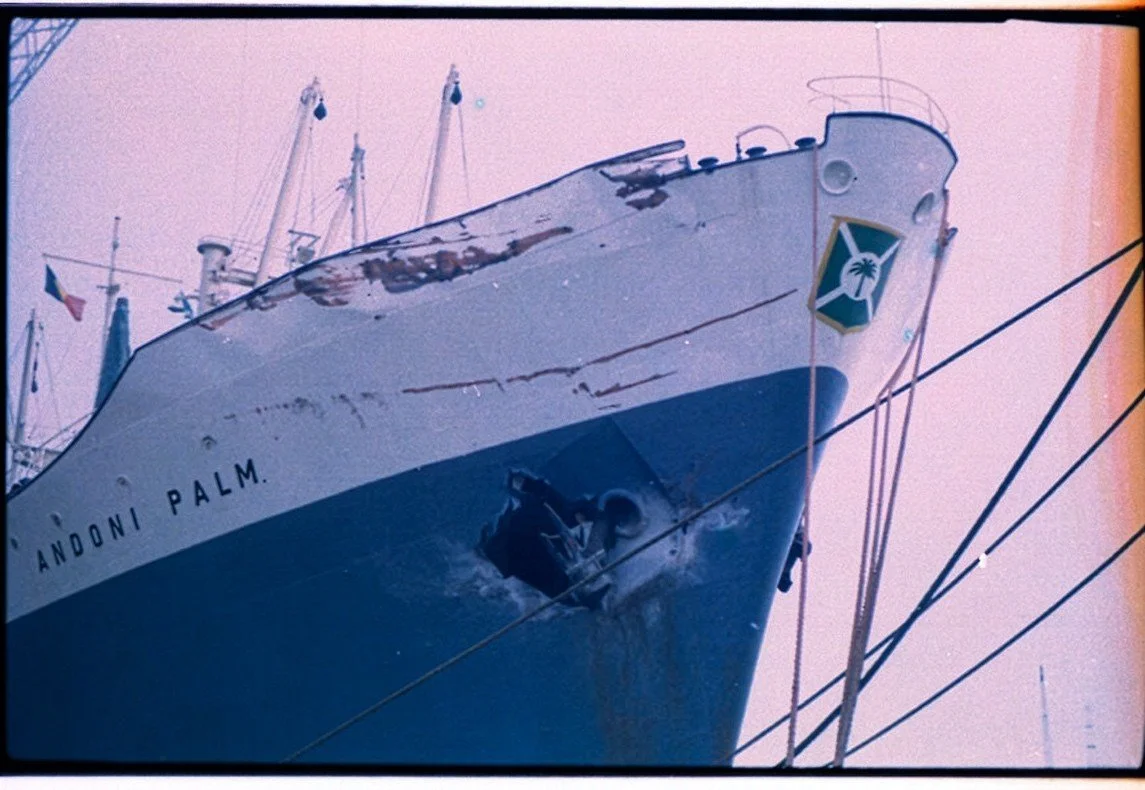
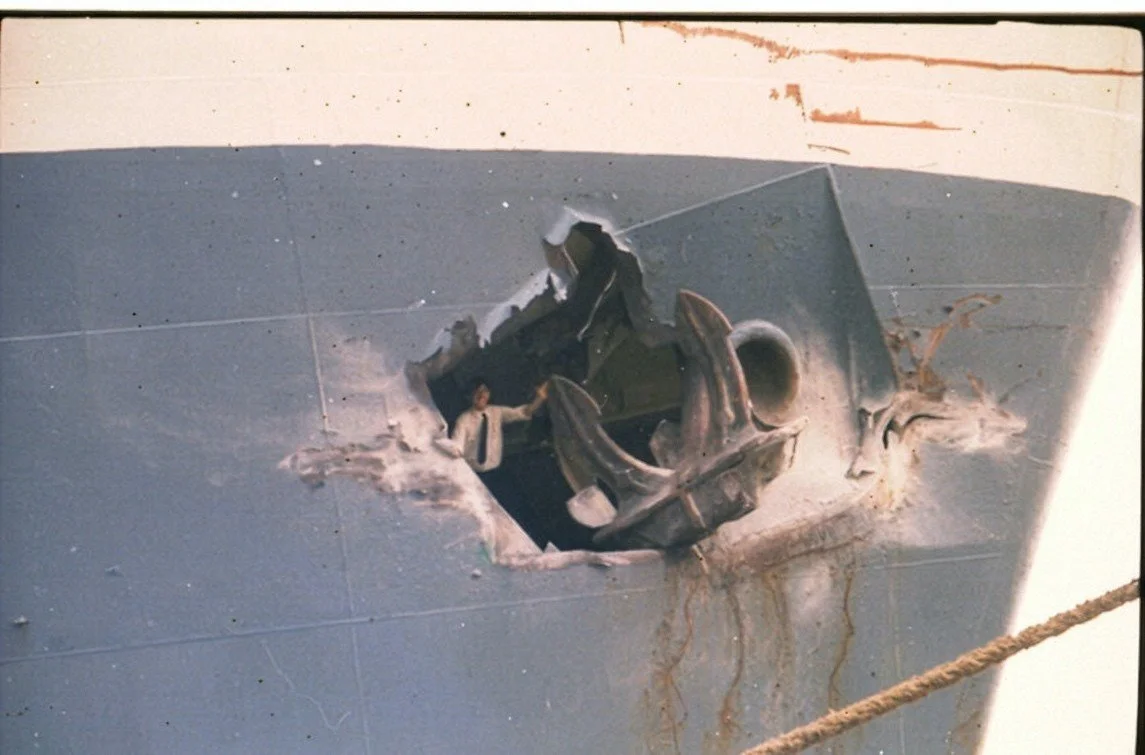
Photographs and description courtesy of Barry Priddis
ANDONI PALM – Struck Whilst Berthed at Avonmouth
In November 1972 the ANDONI PALM was struck by the incoming East German registered vessel, FLAMING, at Avonmouth docks. Though no one was hurt, the ANDONI PALM sustained damage to the boat deck and side plating. Fortunately the lifeboat was unharmed and there was no damage below the waterline so the vessel was able to sail to Liverpool for repairs.
ASHANTI PALM – Royal Yacht BRITANNIA Collision
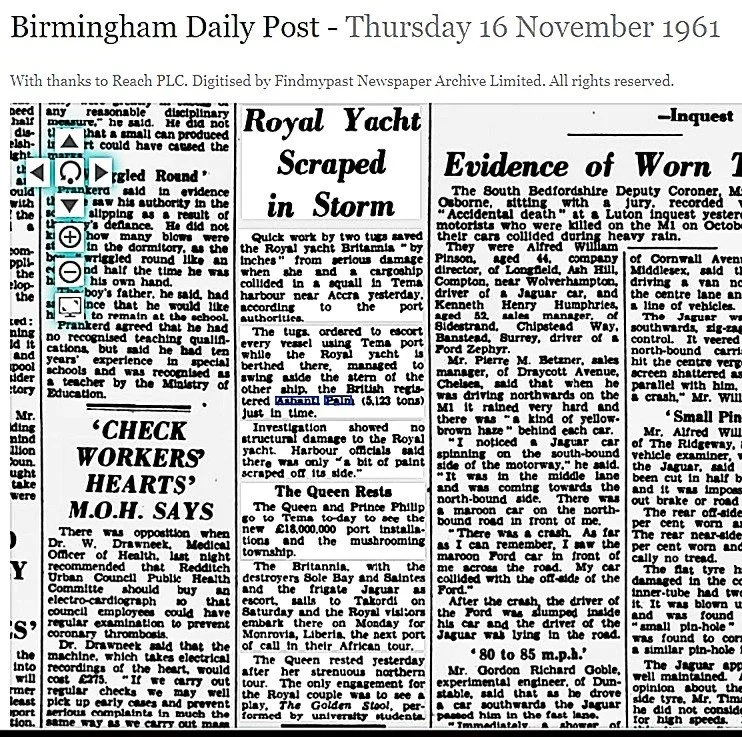
A potentially very embarrassing incident took place in Tema harbour on Wednesday 15 November, 1961, when the ASHANTI PALM came into contact with the Royal Yacht BRITANNIA during a squall while both vessels were manoeuvring in the harbour. Fortunately, there was no serious damage to either vessel. The incident was reported in the Birmingham Daily Post the following day as shown below (thanks to Reach PLC digitised by Findmypast Newspaper Archive Ltd – All rights reserved).
ASHANTI PALM – Sunk in Naples Bay
The ASHANTI PALM was the only Palm Line ship that sank while she was still in service with the company. The loss occurred on the 19th November, 1962 and it was an event that remained in its employees’ minds and was often discussed. Fortunately, there was no loss of life.
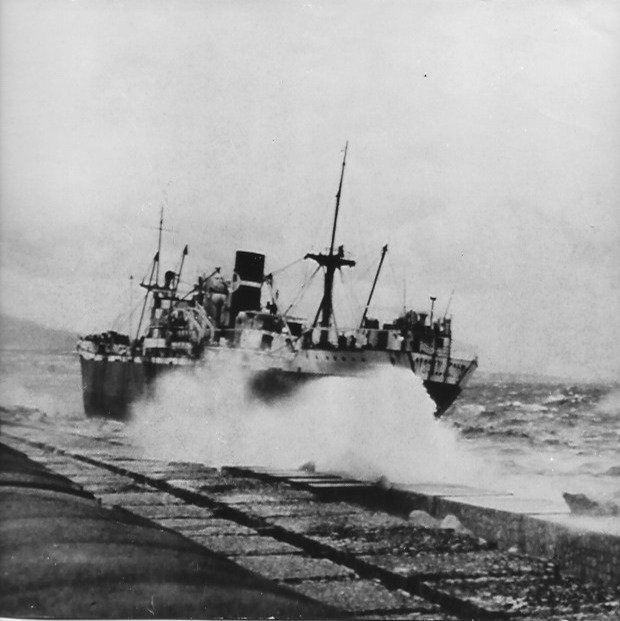
S.S. ASHANTI PALM
Aground on the breakwater outside Naples harbour
(Courtesy of Palm Line Archives)
The Purser on board at the time of the accident, Jeff Friar, one of the ex-company employees who regularly attend the annual reunions, still has memories of the vessel’s final hours. The vessel, which had anchored outside Naples Harbour, dragged her anchor as the weather deteriorated, struck and lodged itself on the breakwater before finally rolling off and sinking.
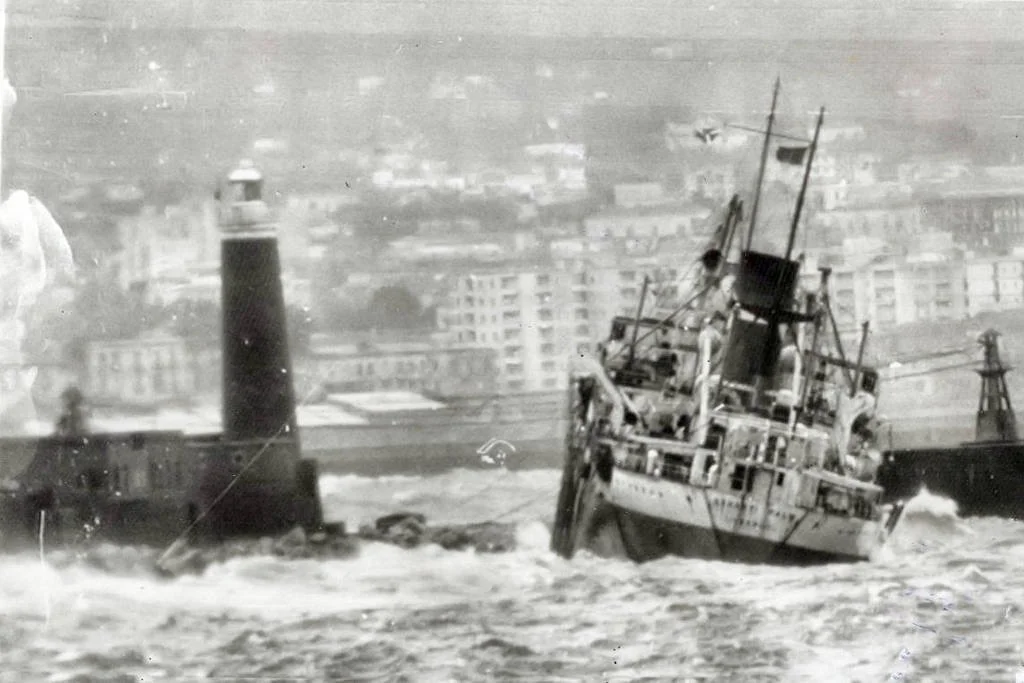
S.S. ASHANTI PALM
Rolling off the breakwater outside Naples harbour before sinking
(Courtesy of Palm Line Archives)
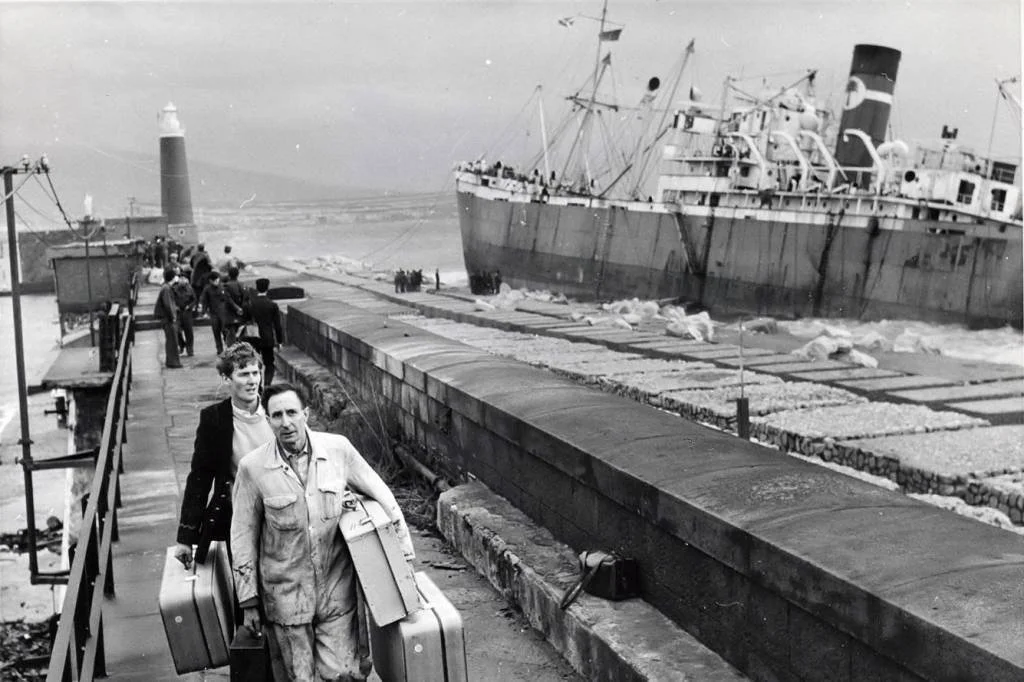
S.S. ASHANTI PALM
Two members of the crew leaving the stricken ship
(Courtesy of Palm Line Archives)
A detailed description of the vessel’s loss is vividly portrayed in the ship’s final log entry made by her Master, Captain R. Anderson. This is reproduced, verbatim, below:
Extract from Deck Log Book on Loss of ASHANTI PALM
18/19 November 1962
This entry was made after the vessel had sunk, but is a true account of the events that led to the vessel’s loss:-
I anchored in Naples Bay at 2332 17th and the vessel was safely anchored in 18/19 fathoms with 4 shackles of cable on the port anchor well in the water at 2338. I remained on the bridge until 0025/18th and went below leaving the 3rd Officer in charge who was instructed to call the 2nd Officer and maintain an anchor watch. The weather was fine with moderate to fresh s.ly breeze. At 0320 the 2nd Officer called me with the information that he considered the vessel was dragging her anchor, the 2nd Officer was instructed to warn the engine room and call the 1st Officer. I immediately went to the bridge to find that the weather had deteriorated considerably and was wind SSW.ly 7/8, heavy rain squalls with moderate heavy swell and rough sea. I could see at once the vessel had dragged – from the relative position of another vessel at anchor (subsequently understood to be “Moline Victory”) and also the breakwater appeared to be much nearer the vessel than when I left the bridge.
The engine telegraph was already on standby and radar set switched on and from the bearings lid on the chart by the 2nd Officer, I appreciated that the vessel had dragged about 600 feet towards the breakwater. The 2nd Officer was sent forward to commence heaving the anchor and the duty deck rating told to call the carpenter, and I ordered slow ahead on the engine room telegraph followed immediately by full ahead and then double full ahead. These engine room instructions were acknowledged and carried out. The cadet appeared on the bridge to assist me and in the meantime the anchor was being weighed. Communications from the forecastle was difficult so the cadet was sent forth to instruct the 2nd Officer to weigh anchor with speed and assist him as necessary., my intentions being to steam out in the bay. The vessel commenced to move ahead but the combined force of the wind and sea acting against the large amount of superstructure above the water line carried her almost broadside onto the rocky foundation of the breakwater, at about 0330 hours. By this time the anchor was off the bottom and the engines were stopped just before the stern grounded. The vessel’s plight was made known by steam whistle signals and tug assistance was called for by Aldis Lamp and Radio Telephone. The watertight door was shut. The vessel was pounding violently and was by now broadside on the rocky foundation of the breakwater. Soundings were taken and indicated that water was entering the vessel. The engine room was instructed to put pumps first on No. I then No. 5 then No.3 and finally to pump all holds. At the same time pumps were working on the engine room. At about 0415 one tug was observed manoeuvring in the harbour entrance but returned inside the shelter of the breakwater. The starboard anchor was lowered to the bottom. The tugs arrived nearby at about 0600 but owing to the weather were unable to get a line on board. At about 0625 tug “San Cataldo” whilst endeavouring to put a line on board ford was carried by a heavy sea against the starboard bow, damaging her superstructure. The tugs then withdrew apparently to await moderating weather. Attempts were made by ship’s rocket line apparatus to pass a line which was received by a tug and a messenger line was taken ford at about 0800 hours. Previous to using the rocket line apparatus, the chief engineer reported personally at about 0700 that the water in the engine room was gaining on the pumps and at 0715 I instructed the engineers to abandon the engine room. The messenger line ford was not hauled in for by this time there was no steam and all holds were flooded. I considered it more advisable to attempt to keep the vessel aground than pull her off. At about 0845 two lifeboats were lowered and the engine and catering ratings sent ashore. The deck ratings assisted in passing lines to the shore in an attempt to hold the vessel against the breakwater but lines were only secured ford as a port official would not permit lines being secured aft. Shortly afterwards the deck ratings were sent ashore. About midday the Officers were instructed to abandon ship. I remained on-board but the vessel was still pounding violently in the continuous severe weather. The wind was still SSW force 7/8 with rough sea and heavy swell. During the afternoon the Officers asked to be allowed to come back on board for the weather moderated quite suddenly and two tugs were secured, one ford and one aft at about 1545 by use of the ship’s lines, but one line parted and the tug cast the other off before any action was taken. Two lines were passed ashore and secured. The weather deteriorated rapidly and at 1635 I ordered all hands to abandon ship for I considered the vessel to be in imminent danger of slipping into deeper water. At 1640 when all hands were ashore the vessel slid off the rocky foundation and turned over to starboard and sank in deep water.
This entry concludes the deck log, the engine and radio log having been left on board.
Ship’s articles and official log landed and articles closed 1700 19th November 1962.
R. Anderson
BADAGRY PALM (II) - An Emergency Dry Docking
During the summer of 1982 the author received a phone call from the Master of the BADAGRY PALM when she was alongside a berth on the river Seine at Rouen, loading a cargo for West Africa. As the vessel had been preparing to leave the quay one of the ABs on board threw a heaving line towards one of the tugs. Unfortunately, he’d jumped the gun somewhat as the tug was too far away. The line didn’t reach and the polypropylene line dropped into the river. Almost instantly, it wrapped itself around the propeller. It then tightened around the tailshaft gland seal and literally cut through it.
That meant the engine had to be immobilised and the tugs pushed the ship back alongside the quay. The ship was more than three quarters full of cargo and the question arose as to whether she could go into dry dock to replace the seal without discharging all or part of the cargo. The second problem was the dry dock in Rouen was too small. This meant the vessel would have to be towed down the River Seine to Le Havre. Fortunately, a suitable dry dock was available there and it was booked. The author flew to Paris, hired a car and drove to Rouen, arriving there that evening.
The French authorities were very concerned about towing the vessel down the river. They were worried that something might go wrong and the river would get blocked. As a result, they insisted on checking over the tugs that had been booked for the tow. The decision as to whether any cargo needed to be discharged was a narrow one. A chance was taken and the ship went into the dry dock immediately on arrival.
Fortunately, a spare tailshaft gland seal was located and it was flown out on a chartered flight. The vessel was safely docked with extra chocks put in place to allow for the increased loading. The replacement seal was fitted without a hitch.
BADAGRY PALM (II)– On the Rocks off Vitoria, Brazil
The 1979 built BADAGRY PALM struck rocks off Vitoria in Brazil around nine o’clock in the evening of 29th July 1985. The vessel had sailed from Santos with almost a full cargo that was made up of a mixture of containers and break bulk. She was due to top off the cargo in Vitoria before sailing for US ports in the Gulf of Mexico.
Prior to the accident, the acting Third Officer, Julie Truman, who was still technically a Deck Cadet, had taken over the watch on the bridge from Garry Broom, the Second Mate, at eight o’clock in the evening. The vessel had been following the safe course that had been set by the Second Mate into Vitoria to the east and north of the Islas dos Picots. Julie was Palm Line’s first and only female officer and by coincidence it was the day of her 21st birthday.
At about a quarter past eight the Master, Dave Brand, joined her on the bridge. At 20.48 the end of the sea passage was rung on the ship’s telegraph and the engine room was put on stand-by for anchoring. Following this, the course of the vessel had to be altered a few times to avoid other vessels, one of which was anchored. What had not been realised was that by this time, the vessel was noticeably to the west of the course laid off on the chart.
As Dave Brand wrote in his report on the incident, just as he was about to reduce speed in preparation for anchoring, the Islas dos Picos inner island was sighted on the starboard side. The helm was ordered hard to port but nevertheless the vessel ran aground at virtually full speed onto the rocks to the west of the island. The engine was twice put full astern in an attempt to pull clear unfortunately without success. A third long attempt was started just before midnight and two hours later, just after high tide, with the engine still pounding away, the vessel pulled clear of the rocks. The vessel anchored safely a little later to check all the soundings and to assess the damage.
It was immediately clear that the damage was very serious. All the vessel’s double bottom tanks were open to the sea. The No. 1 lower hold, which was full of cargo, was flooded. Fortunately, on this ship, the heavy fuel oil was stored in two large deep tanks in the mast houses and not in the double bottoms as is the case with most cargo ships. These tanks were virtually full but intact so there was no pollution.
After discussions with the port authorities, the ship was allowed into the port to allow for further assessment to be carried out. A Lloyd’s Register Surveyor inspected the ship internally. Some cargo had to be moved to get the ship onto a more acceptable trim. Divers were also used to inspect the ship’s bottom revealing that the damage to the bottom shell was extensive.
After much debate, the ship was allowed to sail under her own engines at a very reduced speed to Rio de Janeiro. She was accompanied by a naval tug. She then discharged the cargo prior to entering the floating dock at Niteroi for a full assessment to be made. Miraculously, the damage was confined to the bottom steelwork. The engine and its bedplate and shafting system were unaffected.
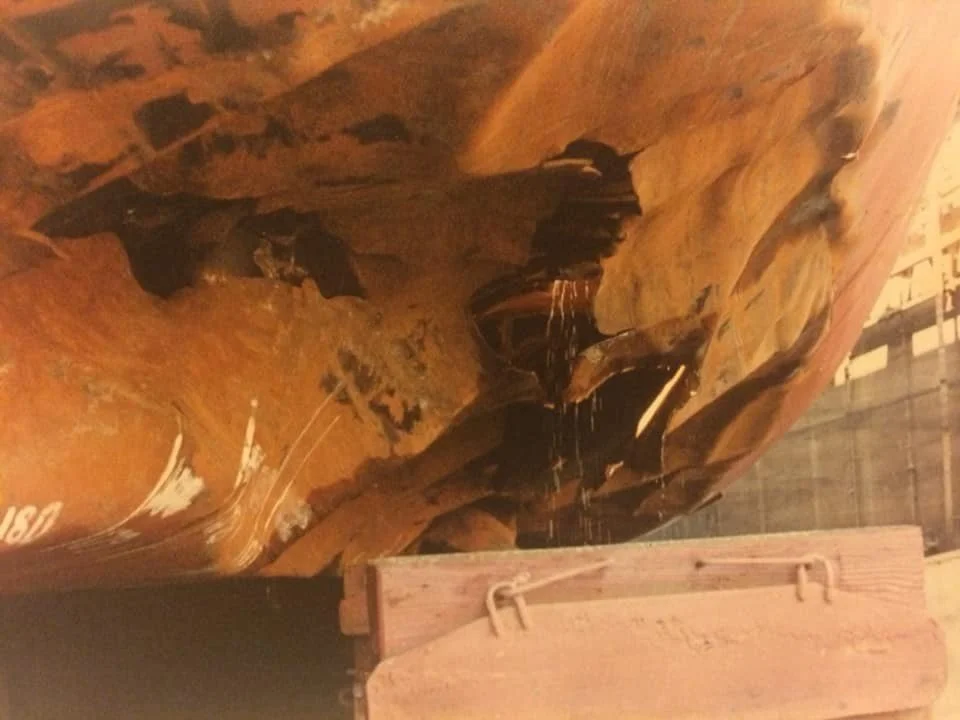
M.V. BADAGRY PALM (II)
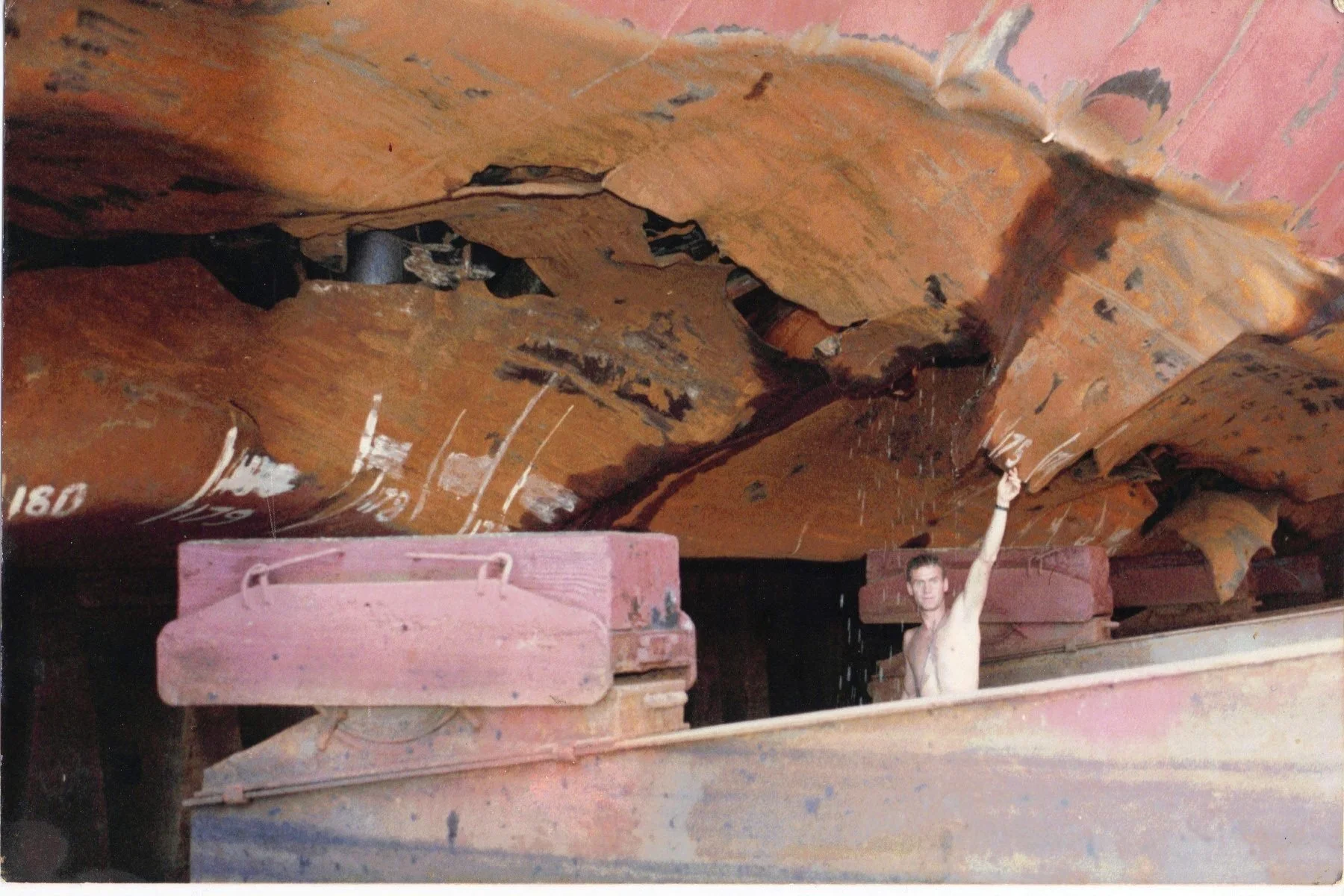
More Bottom Damage (Courtesy of Mark Cable)
It was a close call as to whether the ship was a total constructive loss or the proposed massive structural repair would be commercially viable. Eventually it was decided that the repair could be carried out. A complex plan of cutting out the damaged bottom in sections and then floating in newly prefabricated ones was prepared. In this way the vessel’s bottom was rebuilt. With hindsight, and knowing what was to come, it might have been better if the vessel had been scrapped.
BADAGRY PALM (II) – Sunk Off South Africa
Following the vessel’s repair in Brazil the BADAGRY PALM did one final voyage before being sold by Palm Line in 1986 to Navitrade Holding Corporation, part of the V Ships group. She was re-named CORDIGLIERA and registered in Panama. The ship subsequently changed hands once again in 1989. She then came under the ownership of Sinha Shipping Pte, keeping the same name.
Tragically, on the 14th November 1996, the vessel sank in a storm off the South African coast. At the time she was about ten miles from St Johns and on passage from Durban to Cape Town. She had a full cargo, most of which was made up of steel and granite. Tragically, all of the 23 Indian crew members on board the vessel were lost. There were reports at the time that there were an additional six people onboard when the vessel sank but this has never been confirmed.
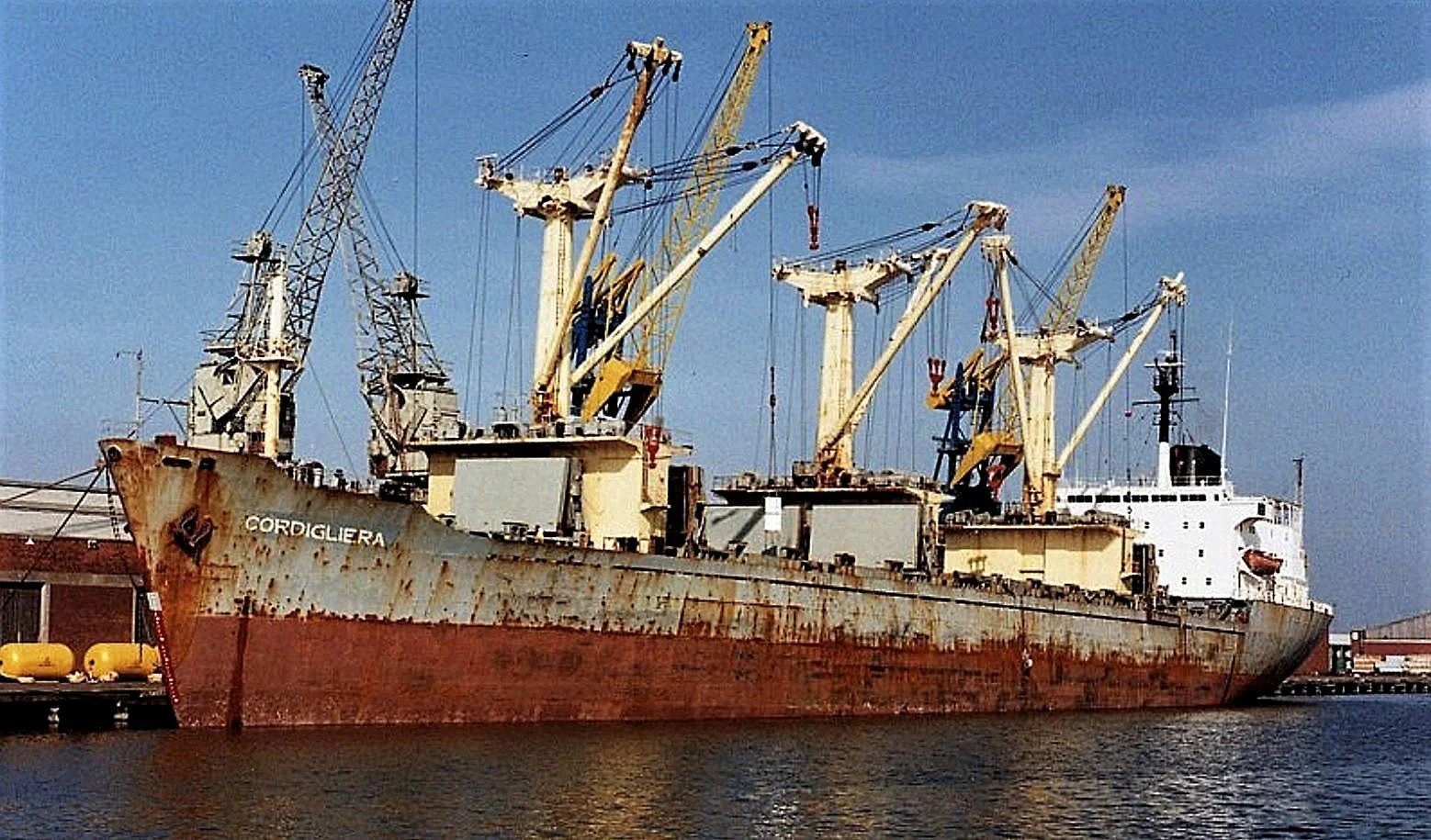
M.V. Cordigliera (ex Badagry Palm) Image courtesy of Trevor Jones.
BAMENDA PALM (I) – Fire with loss of life
A fire on board the BAMENDA PALM on Boxing Day 1968 tragically resulted in the loss of two lives, a passenger and the Junior Engineer.
The fire was thought to have started due to an electrical fault in the Smoke Room/Bar and spread forward along the port alleyway up to and including the 2nd Engineers cabin. This section of the accommodation was subsequently rebuilt and refurbished in Hamburg by Howaldswerft Dockyard.
BAMENDA PALM (II) - Falmouth collision with the OLTET
The author of this page was attending one of the company’s ships in Tilbury on 12th December, 1982, a Saturday morning, as there was some repair work being carried out on board. Whilst having a mid-morning cup of coffee with the Chief Engineer, the Chief Officer rushed in. He’d just heard on the news that the BAMENDA PALM had been involved in a serious collision with a Romanian fish factory ship, the OLTET, at Carrick Roads in Falmouth harbour.
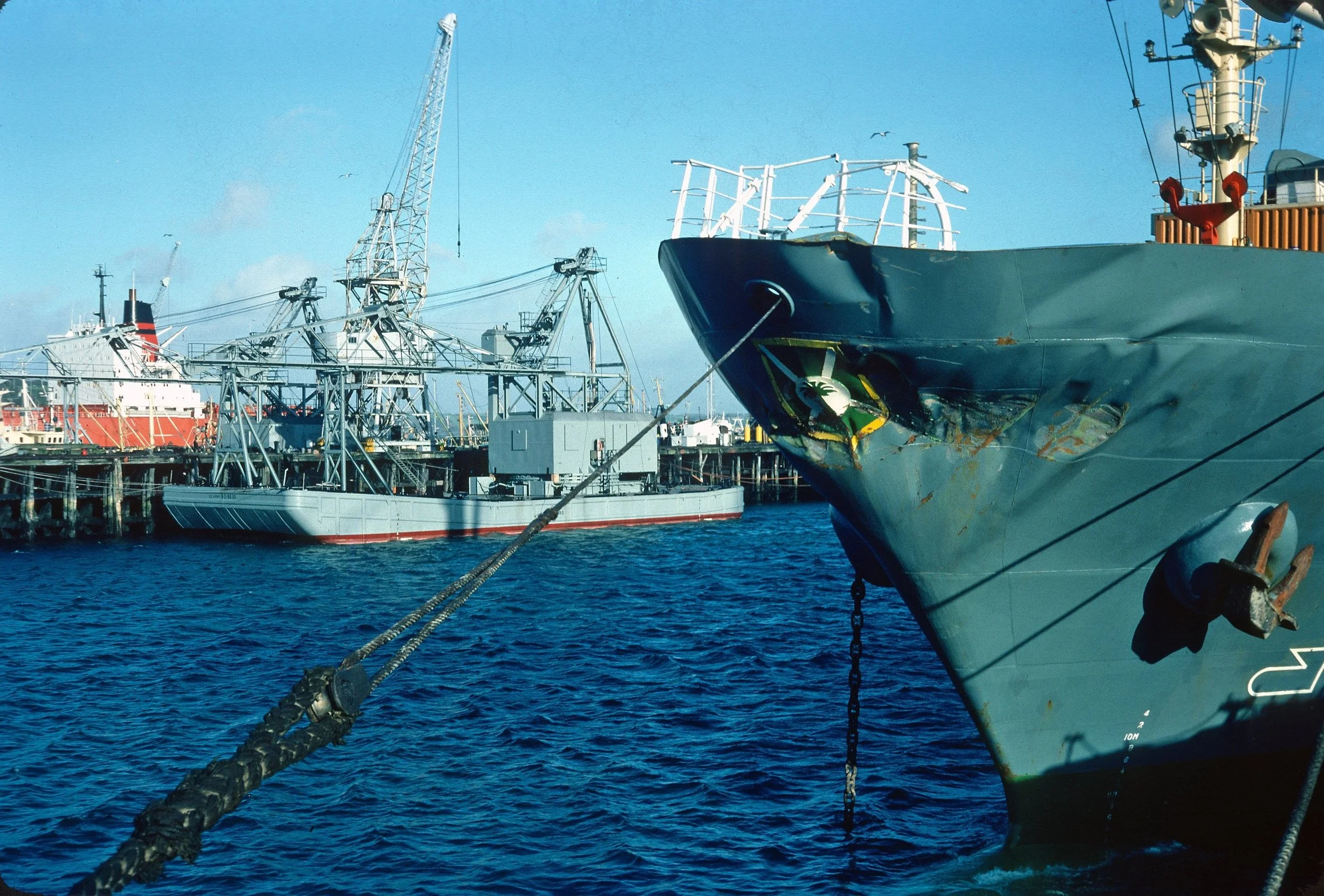
M.V. BAMENDA PALM Bow damage after collision with the OLTET in Carrick Roads
(Courtesy of John Goble)
The author called Bob Owen the Technical Director to check whether he knew about this. Bob’s response was to ask the author why he was not on his way to Falmouth. Six hours later, having called in at home to pick up a change of clothes and other essentials he was on board the ship.
The BAMENDA PALM, had sailed from Liverpool on the evening of 11th December and was due to call into Falmouth briefly to load a 65 tons pusher tug, the WILMOT POINT, for Apapa. There was a northerly gale that night so the vessel made excellent time, arriving outside Carrick Roads shortly after four o’clock in the morning.
Despite the strong winds, the pilot boarded and the ship entered the harbour passing Pendennis Castle. A number of vessels had sought a safe haven from the gale that night and the anchorage was crowded. The Master, George Holeyman, was on the bridge with the pilot and the Chief Officer, John Goble and the Carpenter, George Green, had gone to the forecastle to deal with the anchor.
Unfortunately, the OLTET had just dragged its anchor as a result of the strong winds and was straddling the fairway. By this stage it was too late and the BAMENDA PALM could not be stopped or manoeuvred around the helpless factory ship. The sail effect of the containers loaded on the Palm Line ship’s deck would have made manoeuvring much more difficult. As John Goble described it afterwards, he and George Green bowed to the inevitable. They scrambled down the companionway from the forecastle as fast as possible.
Fortunately, the BAMENDA PALM had slowed considerably. Whilst the impact was not severe, its bulbous bow had struck the mid-ships section of the OLTET puncturing a significant hole in its side beneath the waterline. The BAMENDA PALM immediately berthed at one of the quays to allow its damage to be assessed. The OLTET was taken into the port’s dry dock on the same day.
Although the BAMENDA PALM was almost fully laden, it was possible to trim it by ballasting and fuel transfer to enable an examination of the bulbous bow. Luckily it was not badly damaged and did not need repairing. Whilst the flared bow was more badly damaged, there was only a small hole that was easy to patch over on a temporary basis.
The author worked with George Jenkinson, the Seaforth Welding ship repair manager, to take measurements of the damaged section of the bow. The intention was that a new one could be prefabricated before the vessel’s return to Liverpool at the end of its current voyage
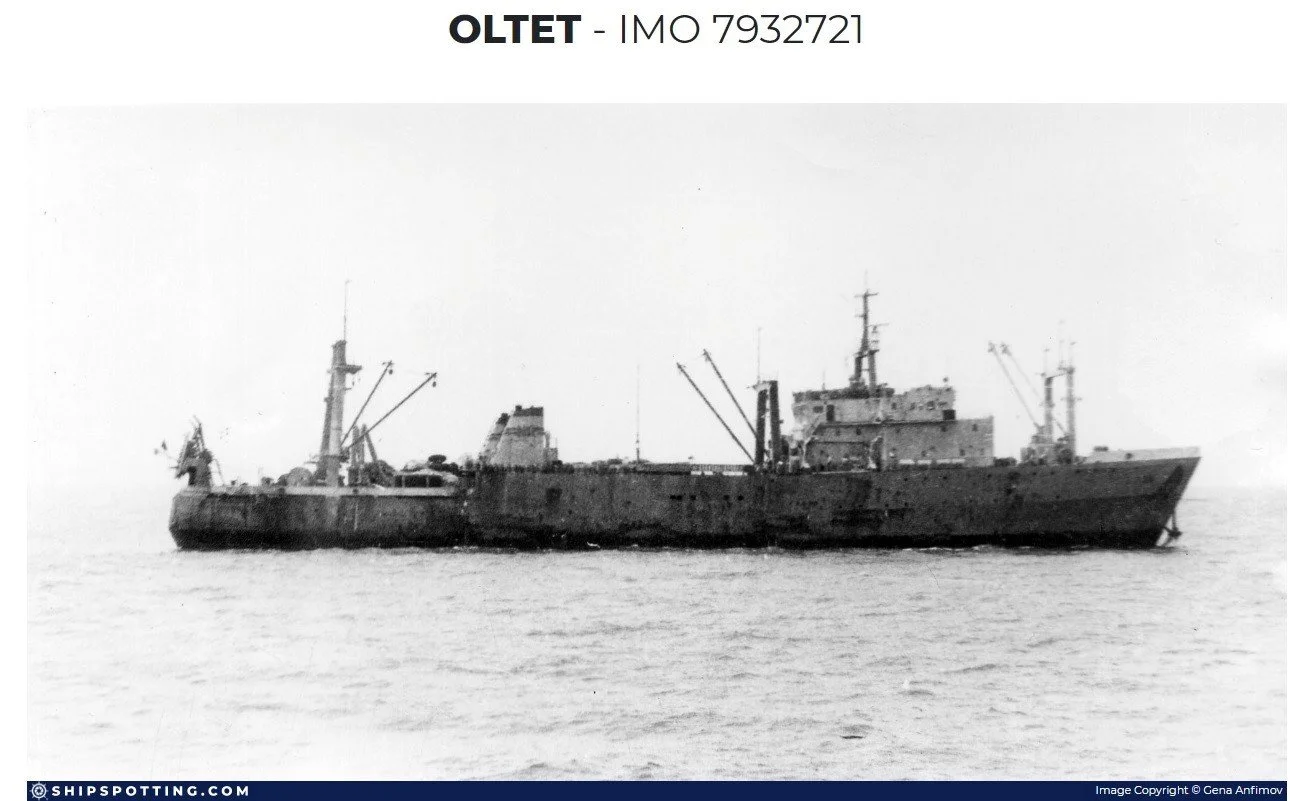
Image courtesy of Gina Anfimov
The author recalls going to look at the OLTET sitting in the dry dock. Members of its crew were standing forlornly around looking at the large hole in its side. They had been promised they’d be going home for Christmas. It was clear the repairs were going to be extensive and take some time. Water was still draining out of the hole in the ship’s side and there were hundreds of pilchards lying in the bottom of the dock.
For the BAMENDA PALM the delay was much shorter. The tug was eventually loaded and the vessel sailed from Falmouth on 18th December, six days after its arrival. A permanent repair was carried out on the vessel’s return to Liverpool by Seaforth Welding.