
UNITED AFRICA COMPANY (1929 – 1949)
Although Lever pulled out of the West African shipping trade in 1923, one of his Niger Company competitors, the African and Eastern Trade Corporation, did the opposite when they bought two ships in 1924. By coincidence, one of these vessels, the 1892 built steamer, the Woodville, was purchased from the Southern Whaling and Sealing Company, which had been a Lever owned company since 1916. Whale oil in those days was used in the manufacture of both soap and margarine. The Woodville had its own special history in that it had carried the body of Ernest Shackleton for burial from South Georgia. The second ship that was purchased was named Ashantian.
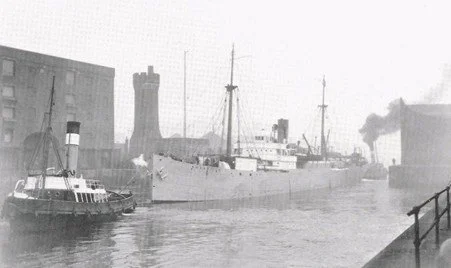
Woodville in Liverpool Docks
African and Eastern then bought two additional ships in 1925 and named them Ethiopian and Nigerian. The disposal of the Bromport Shipping Company meant that Lever Bros and its subsidiary Niger Company, which he had acquired in 1920, were now effectively reliant on third party shipping companies to transport their cargoes. However, the Niger Company did purchase one ship in 1925 from Cunard, the Tyria, which it renamed Ars, after the company motto, Ars Jus Pax. The first Master of the Ars was Captain Astbury who later went on to captain ships in the UAC and then Palm Line fleets before becoming a director of Palm Line.
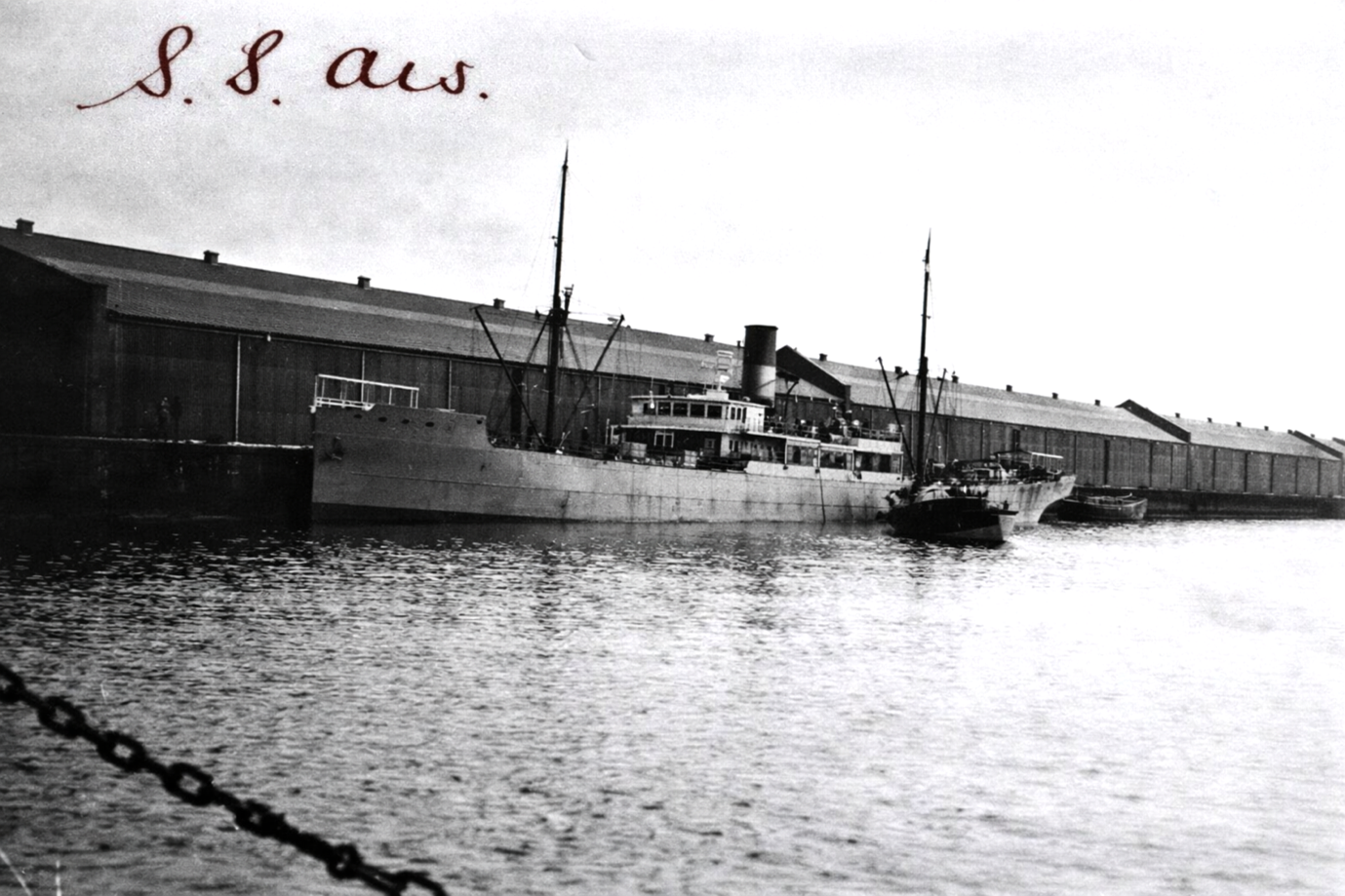
Ars
News of the Niger Company’s purchase of what was assumed to be a Cunard Transatlantic passenger liner had reached Burutu prior the vessel’s call there in 1925 and its arrival was eagerly anticipated. To be blunt, the 28 years old vessel was something of a let-down and not the “fine, fine ship” the company’s staff there had been told to expect. It was described in Roger Kohn’s book, Palm Line: The Coming of Age, as the ship steamed up past Burutu’s Engineer’s Beach, the very old beach bosun was heard to say somewhat scornfully, “Fine, fine new ship, huh, she old past me”.
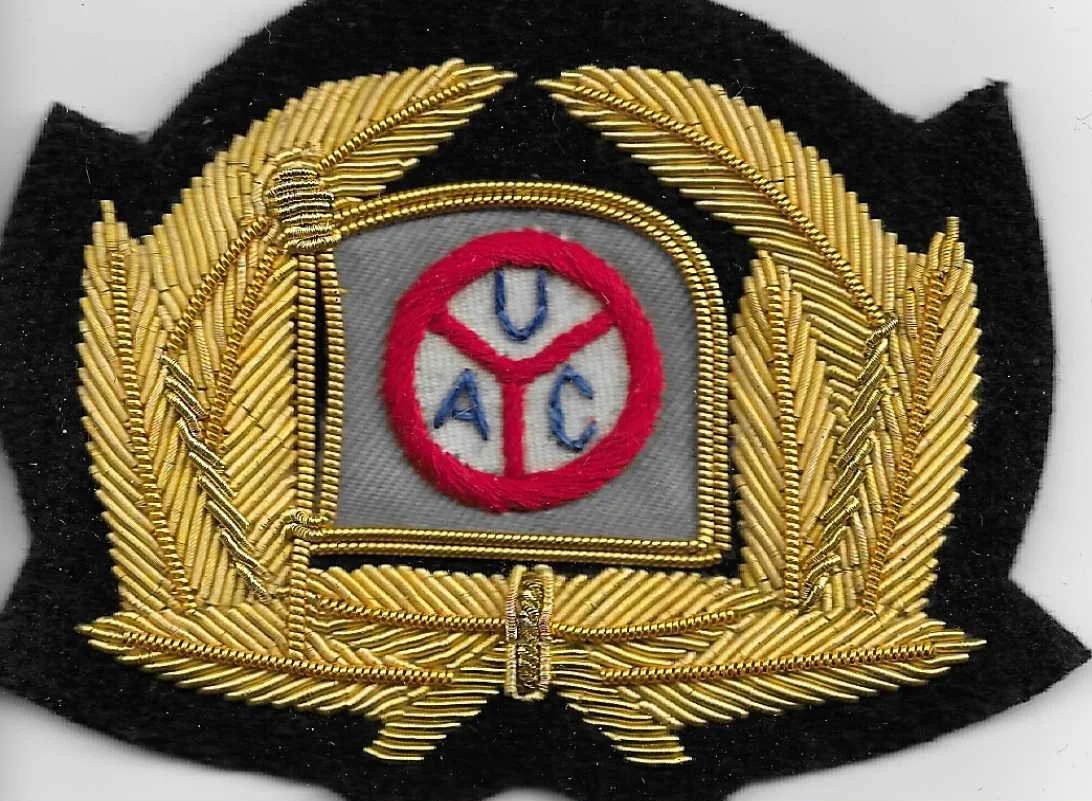
From a shore-based trading perspective the somewhat ruthless competition between the Niger Company and the African and Eastern Trade Corporation resulted in both companies struggling to some extent. The simple answer to this problem was a merger between both companies and the two came together in 1929. The United Africa Company, (UAC) was formed, a wholly owned subsidiary of Lever Brothers. Just two months later, Lever Brothers and the Dutch Margarine Unie came together and Unilever was created. The net result of this was that Unilever, in the guise of UAC, were properly back in ship-owning having inherited the African and Eastern Trade Corporation fleet.
On its formation in 1929, the UAC fleet comprised:
Name
Ars
Ashantian
Ethiopian
Nigerian
Lafian
Tons
2936
2116
2739
3543
3832
Built
1897
1916
1902
1925
1929
Sold
1930
1932
1933
1935
1936
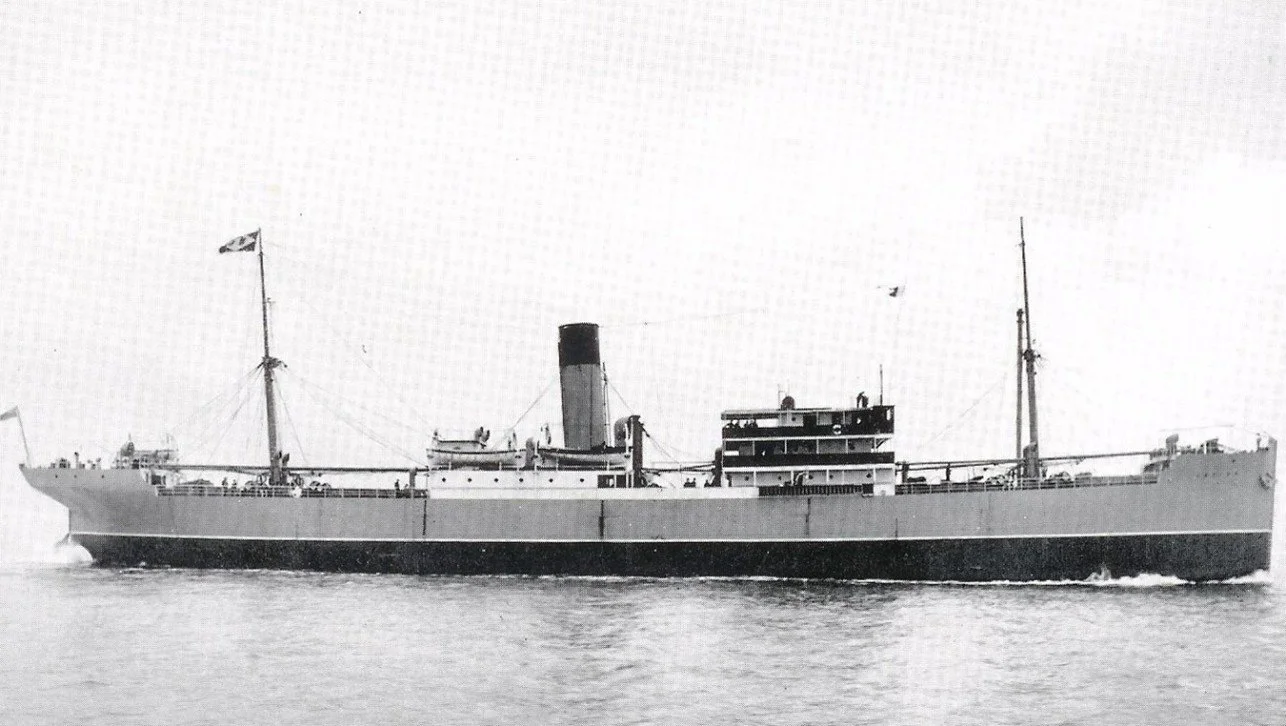
Lafian
The fleet then expanded rapidly with the purchase several second-hand vessels, some of which were only retained for a few years. It was then expanded further with new construction with most of the vessels being built in Germany.
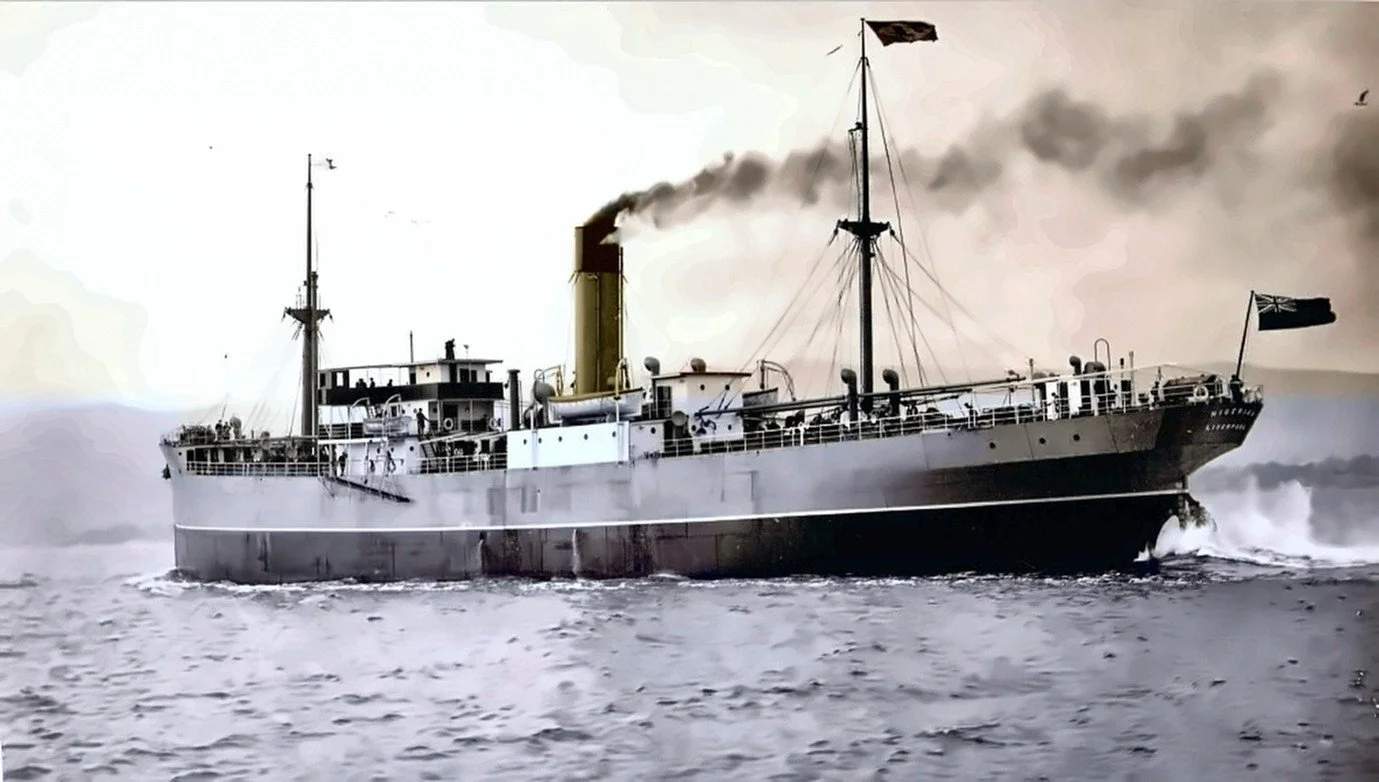
Nigerian, on sea trials on the Clyde
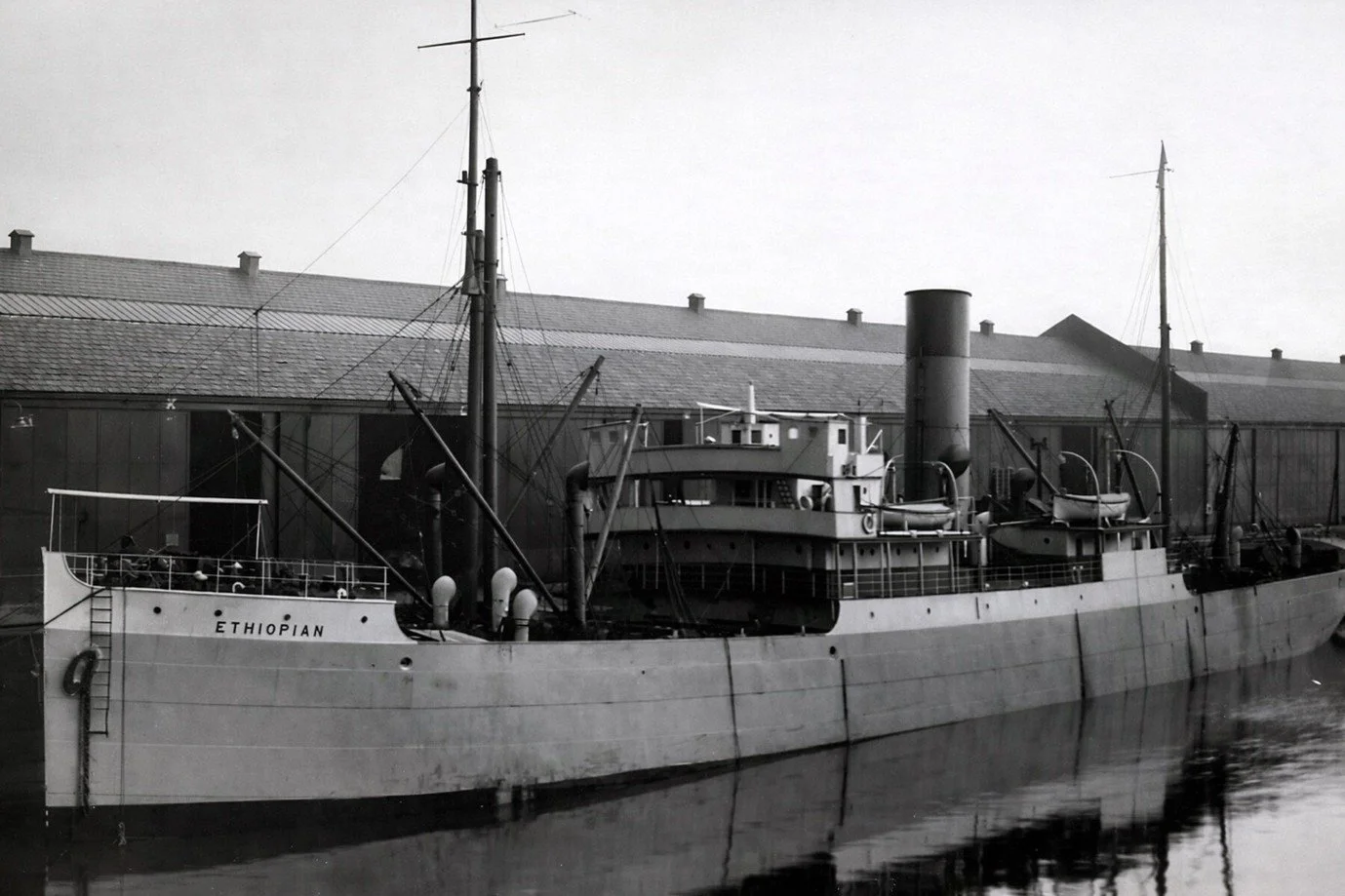
Ethiopian
Somewhat ironically, eight of the German built ships were subsequently sunk by U-Boats during the 1939-1945 war.
The additional ships comprised:
Name
Mendian
Zarian
Kumasian
Lagosian
Congonian
Dahomian
Gambian
Ashantian (II)
Kumasian (II)
Eketian
Nigerian (II)
Ethiopian (II)
Leonian
Guinean
Liberian
Congonian (II)
Matadian
Gambian (II)
Takoradian
Conakrian
Lafian (II)
Warrian
Zarian (II)
Congonian (III)
Kumasian (III)
Lafian (III)
Ashantian (III)
Lagosian (II)
Zarian (III)
Matadian (II)
Nigerian (III)
Tons
3752
3815
3400
5413
5010
5277
3865
4917
4922
1005
5423
5424
5424
5202
5205
4928
4275
5452
5452
4876
4876
1057
4871
6082
7221
7221
5123
5120
5135
6246
5202
Built
1903
1907
1905
1930
1927
1929
1929
1935
1935
1935
1936
1936
1936
1936
1936
1936
1936
1937
1937
1937
1937
1937
1938
1942
1943
1943
1947
1947
1947
1948
1948
Purchased
1930
1931
1931
1932
1933
1933
1933
1935 (new build)
1935 (new build)
1935 (new build)
1936 (new build)
1936 (new build)
1936 (new build)
1936 (new build)
1936 (new build)
1936 (new build)
1936 (new build)
1937 (new build)
1937 (new build)
1937 (new build)
1937 (new build)
1937 (new build)
1938 (new build)
1942 (new build)
1943 (new build)
1943 (new build)
1947 (new build)
1947 (new build)
1947 (new build)
1948 (new build)
1948 (new build)
Sold
1933
1932
1935
1943 (sunk)
1936
1944 (sunk)
1936
1943 (sunk)
1941 (sunk)
1969* & ****
1942 (sunk)
1949**
1949**
1949**
1949**
1940 (sunk)
1944 (sunk)
1949*** & **
1949*** & **
1949
1941 (sunk)
1941 (sunk)
1942 (sunk)
1949**
1949**
1949**
1949**
1949**
1949**
1949**
1949**
* Coastal vessel, later converted into a dumb barge
** Transferred to Palm Line on the formation of the company in 1949
*** Detained in Dakar by Vichy authorities between 1940 & 1946
**** Converted into a dumb barge which explains its longevity
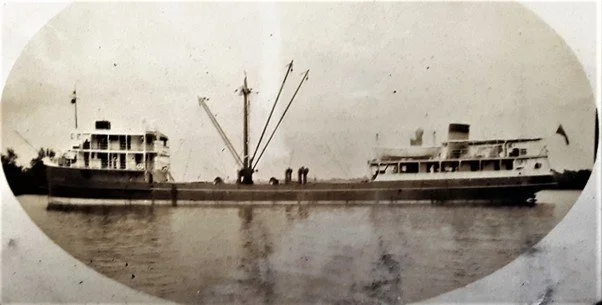
Eketian
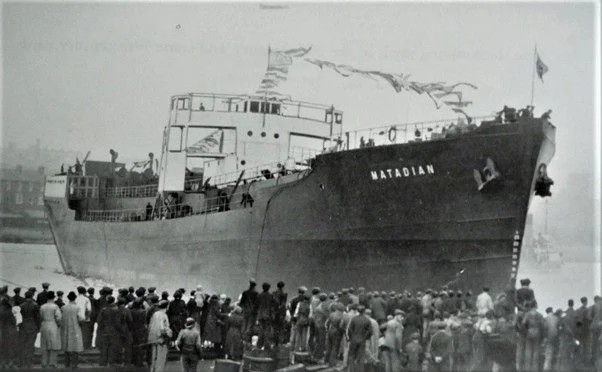
Swan Hunter built Matadian, launched 1 October 1936
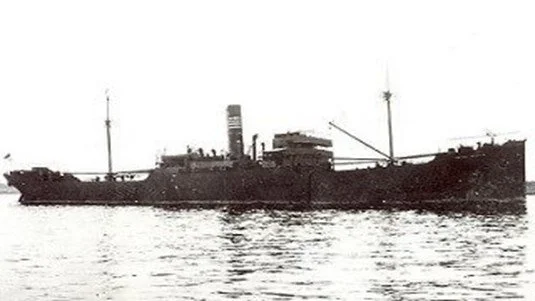
Lauren Branch, soon to be the Mendian
As might be expected, there were several unfortunate incidents on the ships over the twenty years of the company’s existence. Included in these was a fire on the Kumasian in Bromborough Dock in 1935.
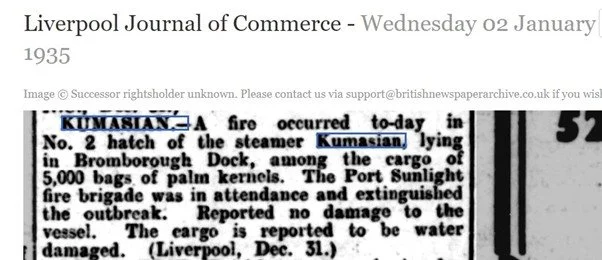
Kumasian Fire in Bromborough
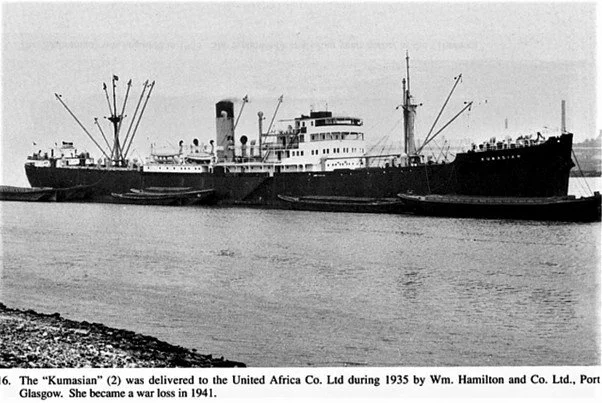
Kumasian (II)
Another accident occurred when the Gambian (II) whilst on her maiden voyage on 2 July 1937, some 10 miles off Beachy Head, collided with a Russian vessel in dense fog.
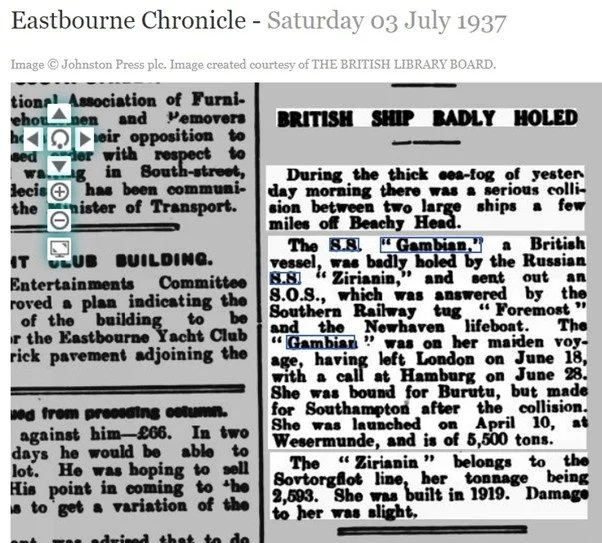
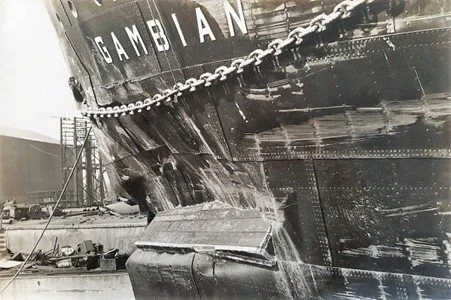
Gambian (II)
In those days the company’s ships’ appearance was considered somewhat less important than their performance and there was little of the later years’ sprucing the ships up for their arrival in home ports. The picture of the Leonian below somewhat illustrates this.
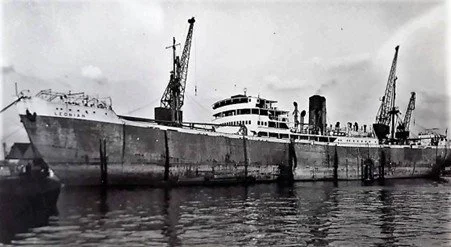
Leonian
Seamen’s wages were also not overly generous as illustrated by the payslip of Sean Keown’s father shown below. Interestingly, although the war had been over for over a year, he was still paid a bonus of over 70% of normal wages as ‘war risk money’.
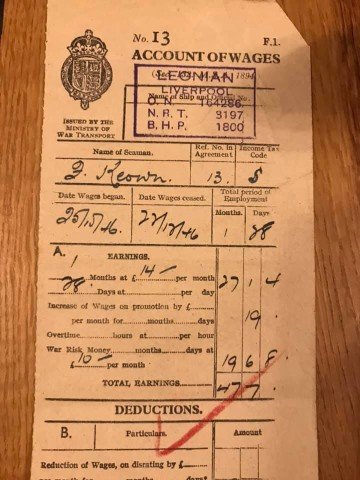
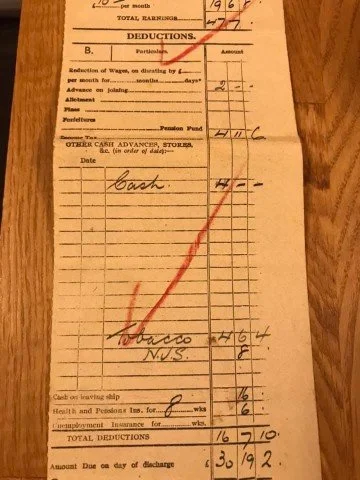
Payslip for nearly 2 months work
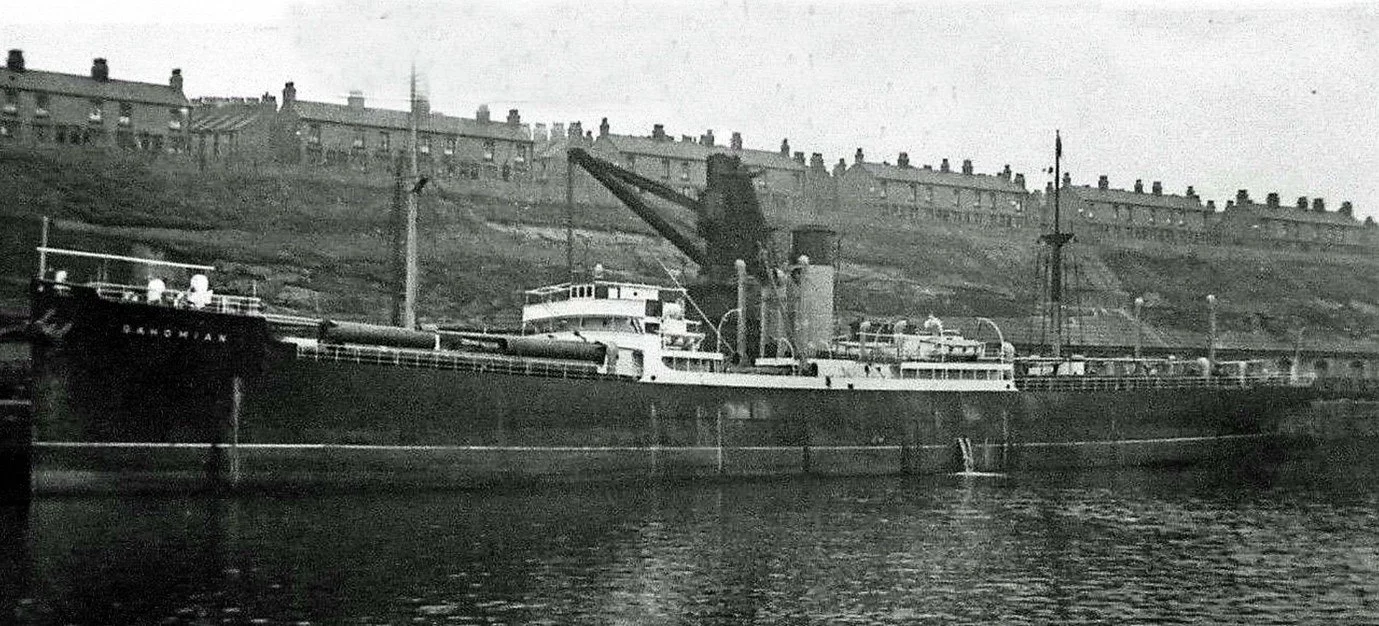
Dahomian
What started as a company operating an old and inefficient fleet, by the mid to late 1930s UAC then had by far the most modern and efficient fleet operating on the West Coast run. They carried virtually all of Unilever’s southbound cargoes of manufactured goods and most of its northbound cargoes of raw materials.
What had started as an ambitious building problem in 1935 when trading conditions with the West Coast were extremely good became somewhat problematical as the political situation in Europe deteriorated. War became a probability and then a certainty. Once war broke out, as had happened during the 1914-1918 conflict, the British Government requisitioned the entire British registered merchant fleet in 1939. This included the 16 ships owned by UAC. Although now nominally under the control of the War Office, the ships continued operating between the UK and the West Coast and were managed by UAC.
Unfortunately, the casualties and losses soon started and over the course of the war nine UAC vessels were sunk by U-Boats. Also, following the fall of France, two of the ships, the 1937 built Gambian and Takoradian, were detained in Dakar for the duration of the war by the Vichy authorities. They had only called at the port to take on bunkers. They were not released until 1946.
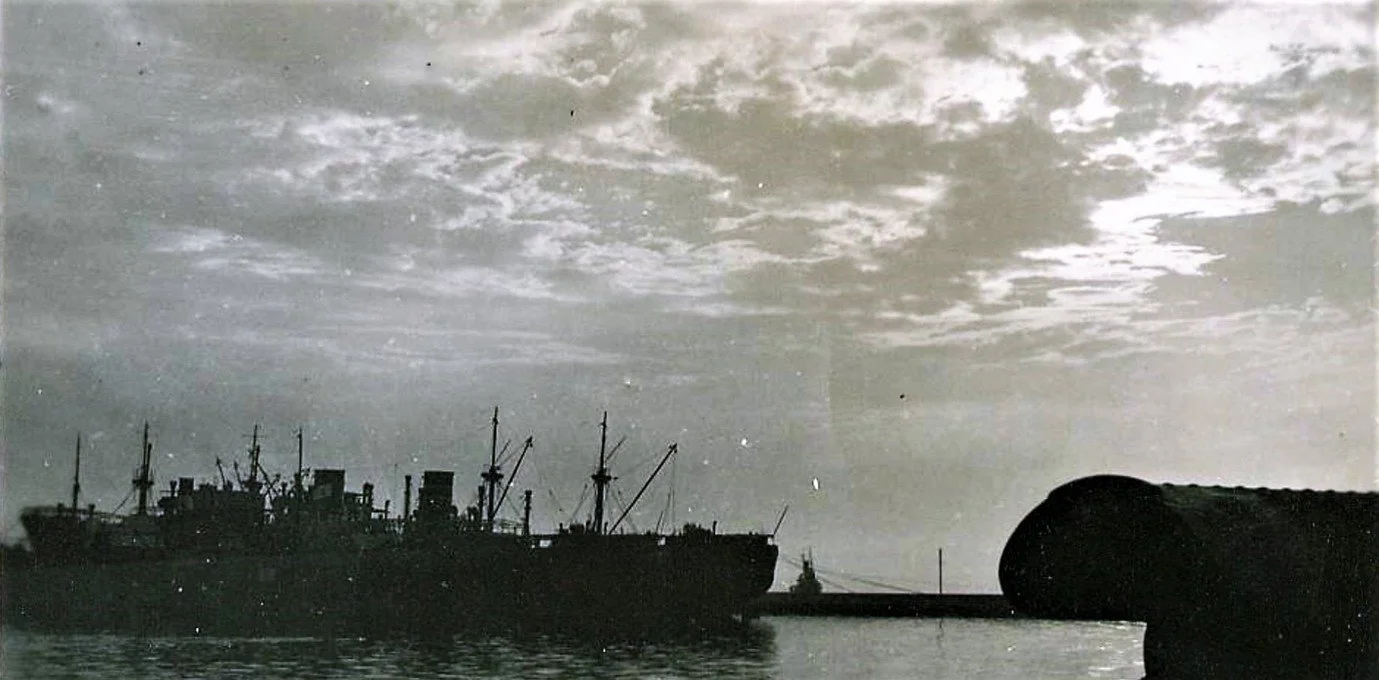
Gambian & Takoradian, interned at Dakar 1940 - 1946
The Guinean was the first vessel to be directly involved in the hostilities. Berthed in St Nazaire in June 1940, on the fall of France, she took on board a significant number of members of the British Expeditionary Force as well as several civilians. During the evacuation there was a moment of panic when a soldier dropped a Mills grenade in the engine room and it rolled between the ship’s two boilers. Fortunately, it was recovered.
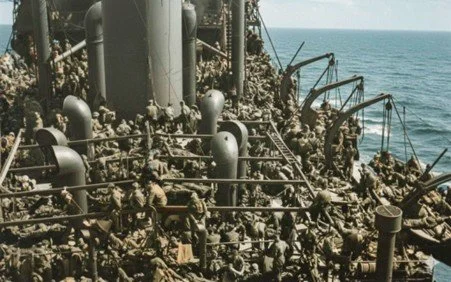
Guinean evacuating British troops across The English Channel from St Nazaire in 1940 as part of Operation Aerial
Later that month the first of the ships, the Zarian, was torpedoed by U-26 off the Scilly Isles. Fortunately, there was no loss of life and the vessel was successfully towed into Falmouth and repaired.
In September the Lagosian was less fortunate when five of the crew were killed when the vessel was bombed in the North Sea off Peterhead. She was also able to make it back to port where she was repaired, only to be sunk by U-591 north of the Azores in September 1943 with the loss of seven lives when on passage between the Mediterranean and the West Coast.
The first ship in the UAC fleet to be sunk was the Congonian in October 1940 when she was torpedoed by U-65 off Freetown. There was no loss of life. The next vessel to be sunk by torpedo from U-74 in the North Atlantic off the Irish Coast in August 1941 was the Kumasian, again with no loss of life. The following month, the Lafian (II) was lost, again sunk by submarine, this time U-107, 500 miles off the Azores.
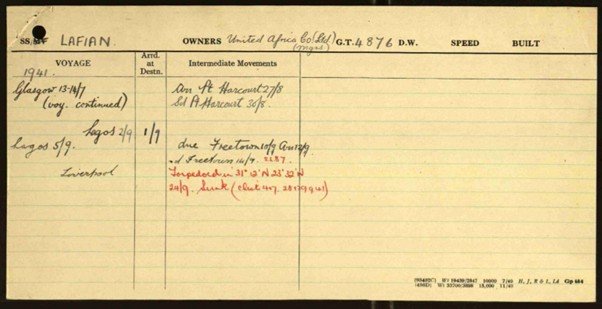
Lafian movement card, courtesy of the national archives at Kew
Sunk on 8 December 1941 by U107
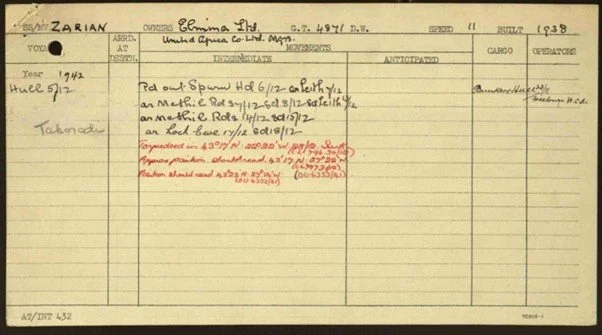
Zarian movement card, courtesy of the national archives at Kew.
Sunk on 28 December 1942 by U-591
The worst loss of life in a single incident occurred when the Ashantian, the second UAC vessel to bear that name, was sunk by U-414, west of Ireland, in April 1943 with the loss of fourteen lives. In the twenty years of its existence there were three vessels named Ashantian in the UAC fleet and not one of them made it to the breaker’s yard. The first named beached after a fire immobilised the engine and was declared a constructive total loss. The third vessel to bear the name, under its new name, Ashanti Palm, drifted onto the Naples breakwater and sank after dragging its anchor in a gale.
In March 1944, the Matadian was sunk by U-66 off West Africa and the final loss, the following month, was the Dahomian which was sunk by U-852 in the Mediterranean Sea with the loss of two lives. Other ships in the fleet had been damaged but survived. At the outbreak of the war the UAC fleet comprised 18 ships and in the next five years, nine of them had been sunk.
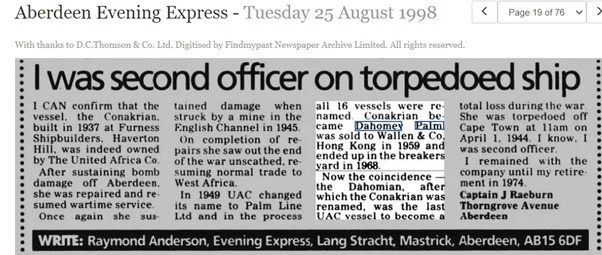
Captain Raeburn who later was to become a manager for the Palm Line Agencies in Lagos, was Second officer on the Conakrian during the war and he wrote the following letter in 1998. Following the bomb damage off Aberdeen earlier in the war, the vessel struck a mine in the English Channel in 1945 but again was successfully repaired.
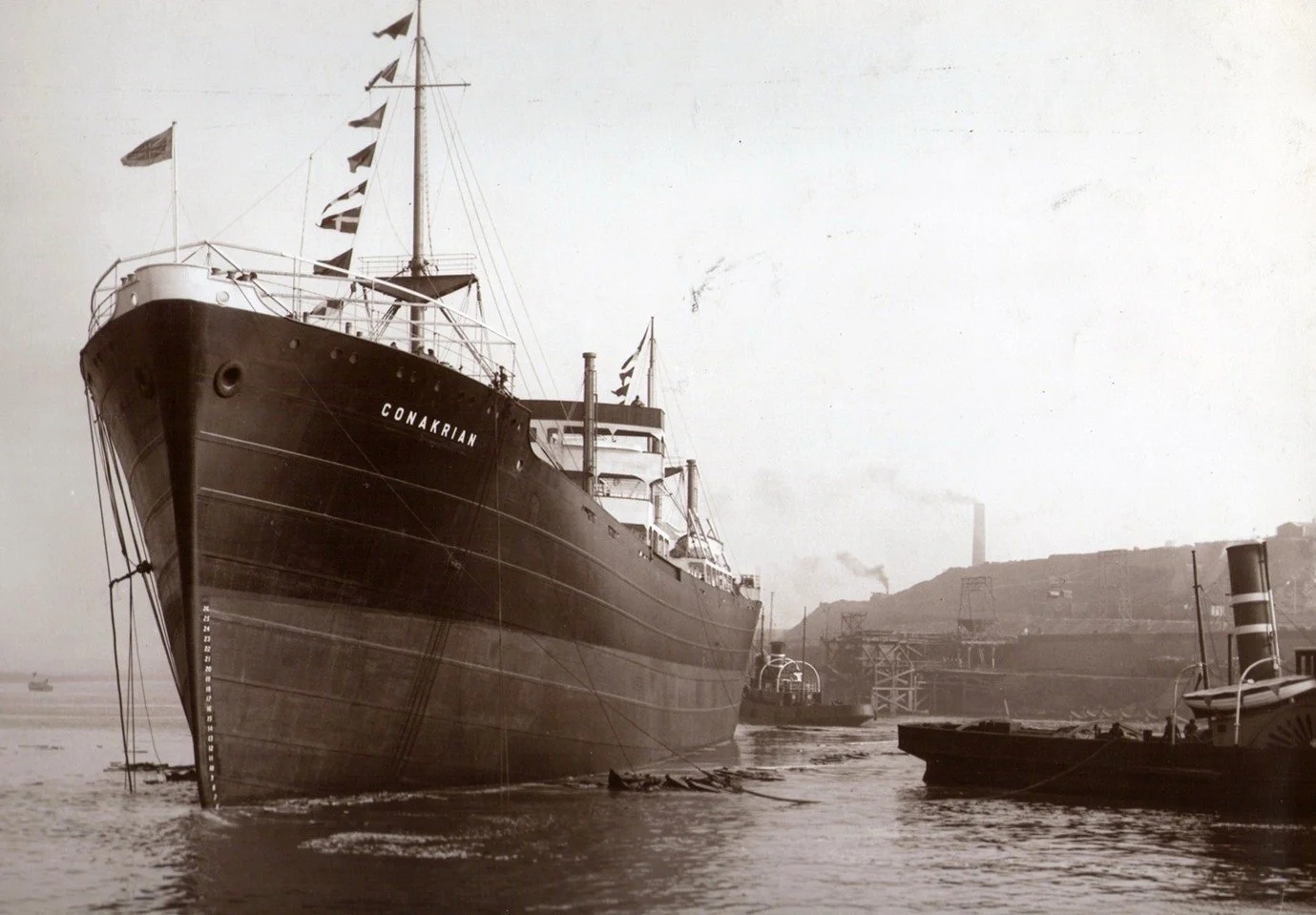
Conakrian
During the course of the war, three more ships were built and added to the fleet, the Congonian (III), Kumasian (III) and Lafian (III), so when the requisitioned ships were returned to full UAC ownership in 1946 the fleet comprised 12 vessels. In the next two years five more ships were built and added to the fleet, the Ashantian (III), Zarian (III), Lagosian (II), Matadian (II) and the Nigerian (III). Now with a fleet of fifteen ships, this was almost as many as the eighteen it owned at the outbreak of the war. The missing three were made up by chartering in for three years the vessels Fort St Joseph, Fort McPherson and Fort Moose. These ships were part of a large group of ships built in Canada, similar to the American Liberty ships, for the British Ministry of War Transport.
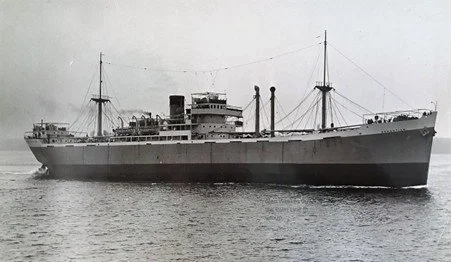
Ashantian
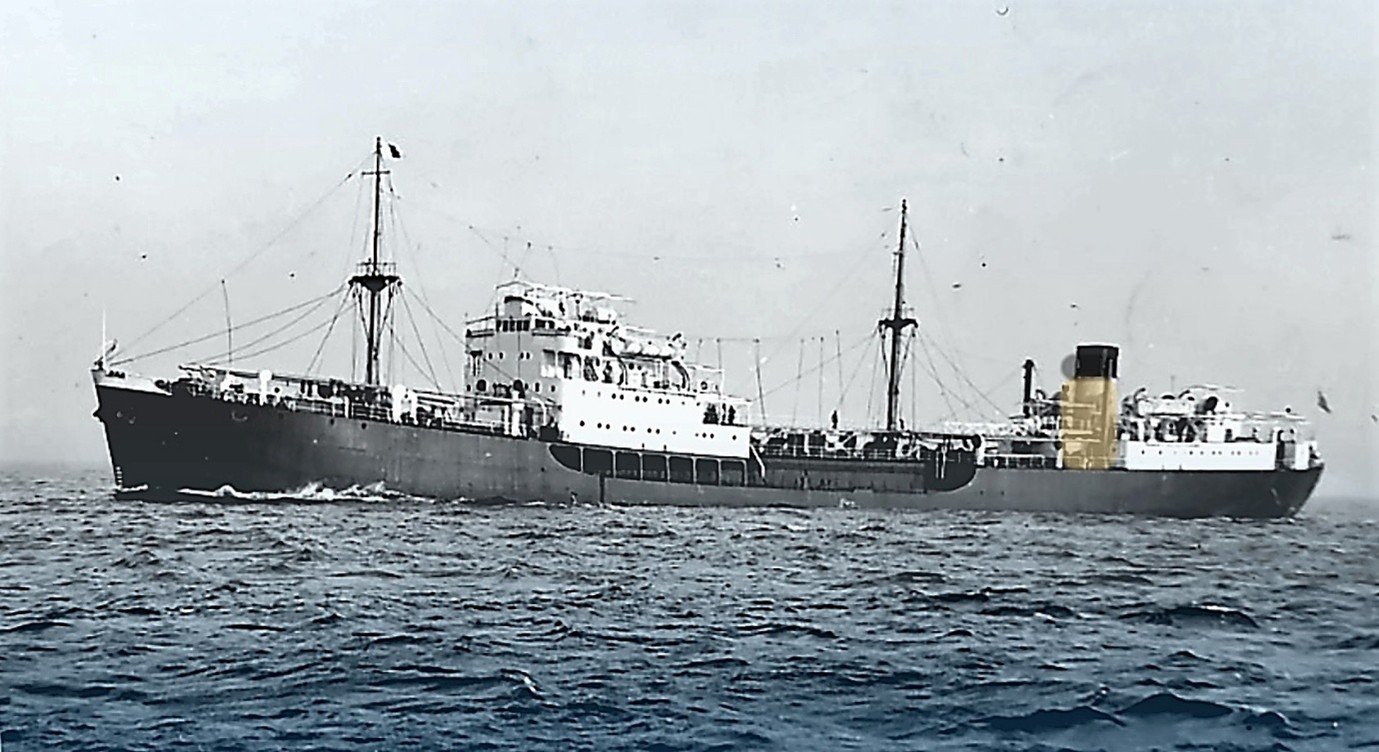
Matadian (II), another of the UAC Bulk Vegetable Oil Carriers
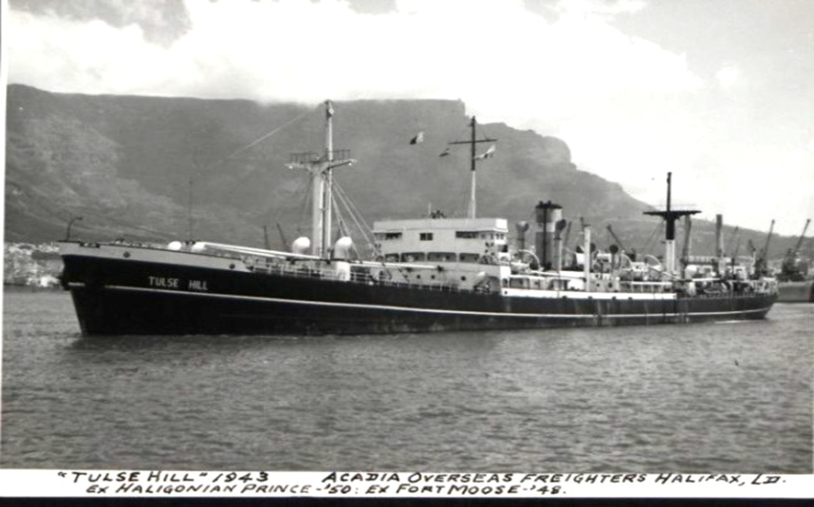
Tulse Hill, later renamed Fort Moose
One of three Canadian-Built Ships Chartered to UAC 1946 - 1949
The trading conditions that had prevailed for shipowners before the war were very different in 1946. This was especially the case with shipping to and from West Africa where the political and economic situation had changed. The days of Empire were effectively over and major changes were on the way.
The British shipping companies now competing for cargoes, UAC, Elder Dempster and John Holt, had all suffered serious losses to their fleets so there was a general shortage of ships for the increasingly available cargoes. In order reduce the most serious effect of competition, namely a reduction in shipping rates, a ‘joint service’ was somewhat reluctantly proposed and agreed and this prevailed despite some reluctance from the owners. This was a big problem for UAC which had previously had a monopoly on carrying the Unilever cargoes. They effectively lost control of the carriage of their own raw materials from the coast. However, the South and Northbound cargoes were plentiful and the profit margins were good.
Whilst most of the fleet were cargo ships, a few were bulk vegetable oil carriers, effectively tankers such as the Congonian, shown below discharging palm oil at the West Thurrock factory of Thomas Hedley & Co.
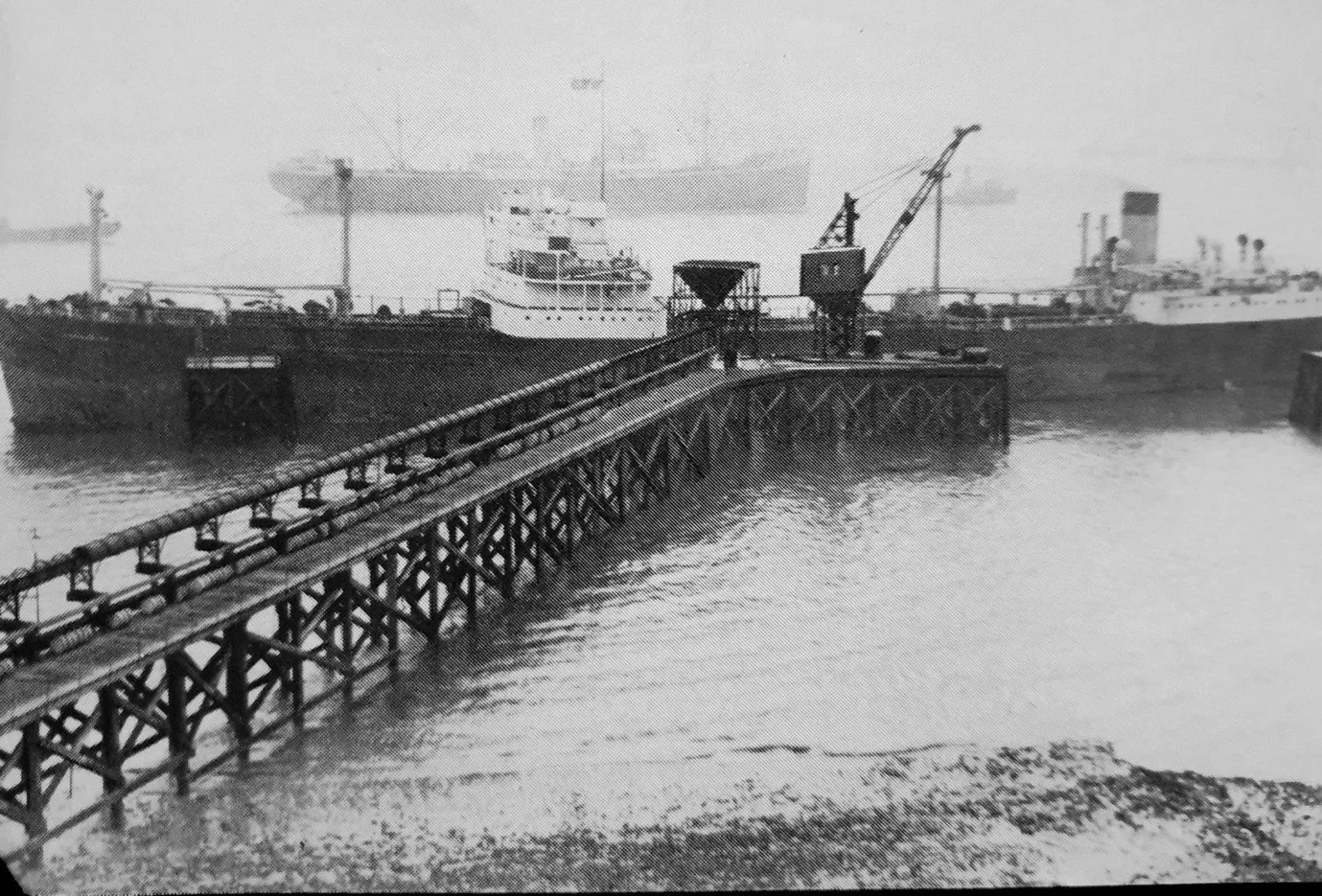
Congonian at West Thurrock
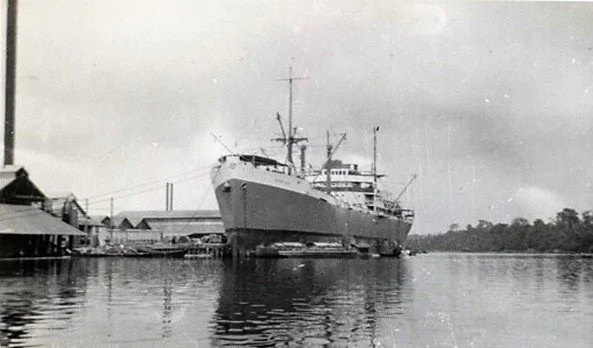
Zarian at Sapele
Non-war related accidents on the ships continued. On 6 October 1948, the Takoradian caught fire whilst in port in Copenhagen as described in the picture and newspaper articles below.
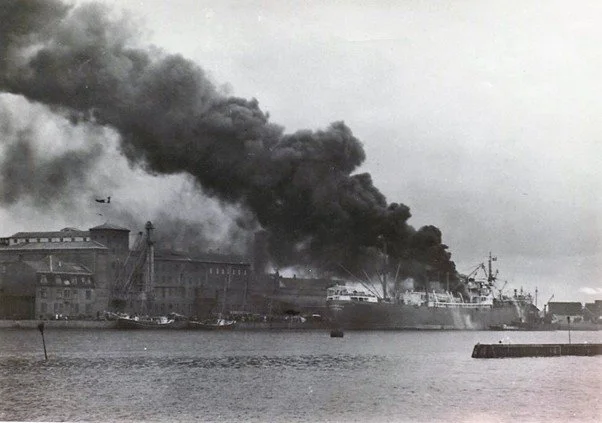
Takoradian on fire at her berth in Copenhagen – 6 October 1948
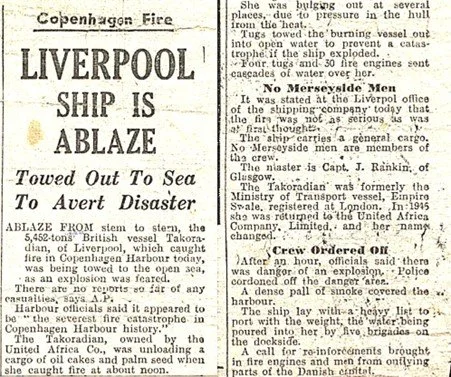
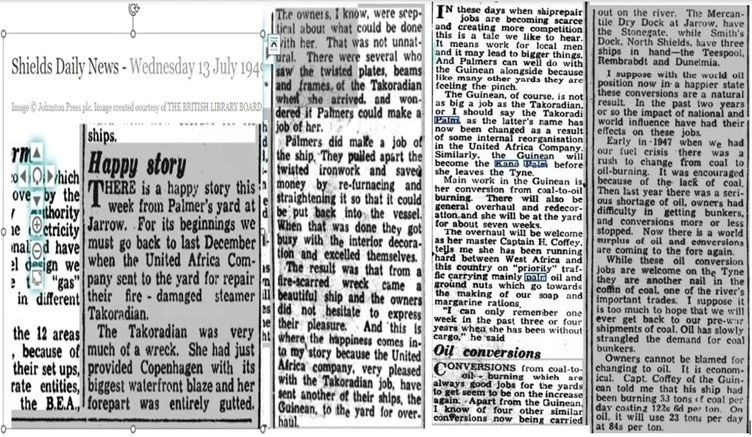
Takoradi Palm Fire in Copenhagen
A brief but dramatic film of the fire is captured on the YouTube.com clip following the standard adverts with the link: https://www.youtube.com/watch?v=r8N6ZZcGEC0
UAC management of their fleet was made difficult and partially restricted because of internal pressure from the non-shipping elements of the company. The other shipping companies operating in West Africa had no such problems. After a careful review it was decided that the fleet could be managed more effectively and profitably if it could operate independently of UAC. Whilst still a wholly owned subsidiary of the company, as an independent shipping line it would have full and independent control over the movement of its ships and the cargoes it carried.
As a result, on 16 February 1949 at an extraordinary meeting of the UAC shareholders it was decided to form the new company. To do this they revived the Articles of Association of the now dormant Lever company, the Southern Whaling and Sealing Company, and named the company Palm Line. The fifteen owned ships were renamed as follows:
Previous Name
Ashantian
Conakrian
Congonian
Ethiopian
Gambian
Guinean
Kumasian
Lafian
Lagosian
Leonian
Liberian
Matadian
Nigerian
Takoradian
Zarian
Palm Line was born…..
New Name
Ashanti Palm
Dahomey Palm
Opobo Palm
Benin Palm
Gambia Palm
Kano Palm
Kumasi Palm
Oguta Palm
Lagos Palm
Mendi Palm
Volta Palm
Matadi Palm
Niger Palm
Takoradi Palm
Lokoja Palm