
BAMENDA PALM (II) – Eight Stowaways Murdered
Ten years after the sale of the BAMENDA PALM by Palm Line in 1985, the 1977 Korean built vessel gained horrific notoriety. The incident that precipitated this had taken place three years earlier. After initially being renamed ARKO GLORY the vessel was then renamed MC RUBY in 1990 by her new Ukrainian owners.
In 1992, nine stowaways were found on board the vessel when it was steaming north off Portugal. Some days later, eight of them were murdered by some of the senior officers from the ship’s crew. The sole remaining stowaway managed to escape and remain hidden in the hold until the vessel docked in France.
It wasn’t until three years later that the ship’s Captain and Chief Officer were sentenced to life imprisonment in a court in Rouen for those murders. Three other members of the crew were sentenced to 20 years imprisonment. There was a detailed description of this terrible incident in the Independent newspaper on 11th December 1995. The report was filed by the paper’s correspondent and journalist, Raymond Whittaker. It is reproduced below.
The Ukrainian captain of a cargo ship and his second-in-command were sentenced to life imprisonment in the French city of Rouen yesterday for killing eight African stowaways at sea off Portugal in November 1992. Three other Ukrainian crew members of the vessel, the MC Ruby, were jailed for 20 years for their part in a tale of savagery on the high seas.
The court heard that seven Ghanaians and one Cameroonian who hid aboard the ship were beaten with an iron bar, shot and dumped in the Atlantic Ocean. The killings only came to light because one Ghanaian stowaway, Kingsley Ofusu, escaped the massacre and hid in the hold of the vessel, drinking his own urine to survive. The crew knew he was on board, and stalked him for three days, but he evaded them and slipped ashore when the MC Ruby docked in Le Havre, where he alerted the police. He took a handful of cocoa beans from the hold to support his account.
As the story unfolded in court, it raised worrying questions over how often such incidents might occur at sea. The 23-member Ukrainian crew were envied at home, since they were paid in hard currency. But they knew they faced heavy fines if they arrived with undocumented passengers at their next port of call.
What happened after the stowaways, crazed with thirst, came out on deck to search for water, prompted the prosecutor to describe the captain, 60-year-old Vladimir Ilnitskiy, as a man "who forbade nothing, a Pontius Pilate who seeks refuge in false innocence".
The stowaways, seeking to escape desperate poverty at home, slipped on board the MC Ruby, registered in the Bahamas, when it docked at the Ghanaian port of Takoradi, on her way to Hamburg. But weakened by more than a week without water, some risked giving themselves up, a decision which condemned all but one of them to a brutal death. The rest were caught and locked up, then led out one by one to be killed.
It emerged that the strongest personality on board was the first mate, Valery Artemenko, also sentenced to life. None of the accused denied the murders, but according to the men with him in the dock, Artemenko was the ringleader. Last month he attempted to commit suicide in his cell, but was pulled down by two cellmates after trying to hang himself from a window with a tracksuit. He was not seriously hurt.
The three crew members, Oleg Mikhailevsky, Petr Bondarenko and Sergei Romashenko, were jailed for 20 years for kidnapping, murder and attempted murder. The jury acquitted a sixth defendant, Dzhamal Arakhamiya, from the separatist Georgian region of Abkhazia, who was accused of complicity in the crimes. He said he had refused to participate in the murders
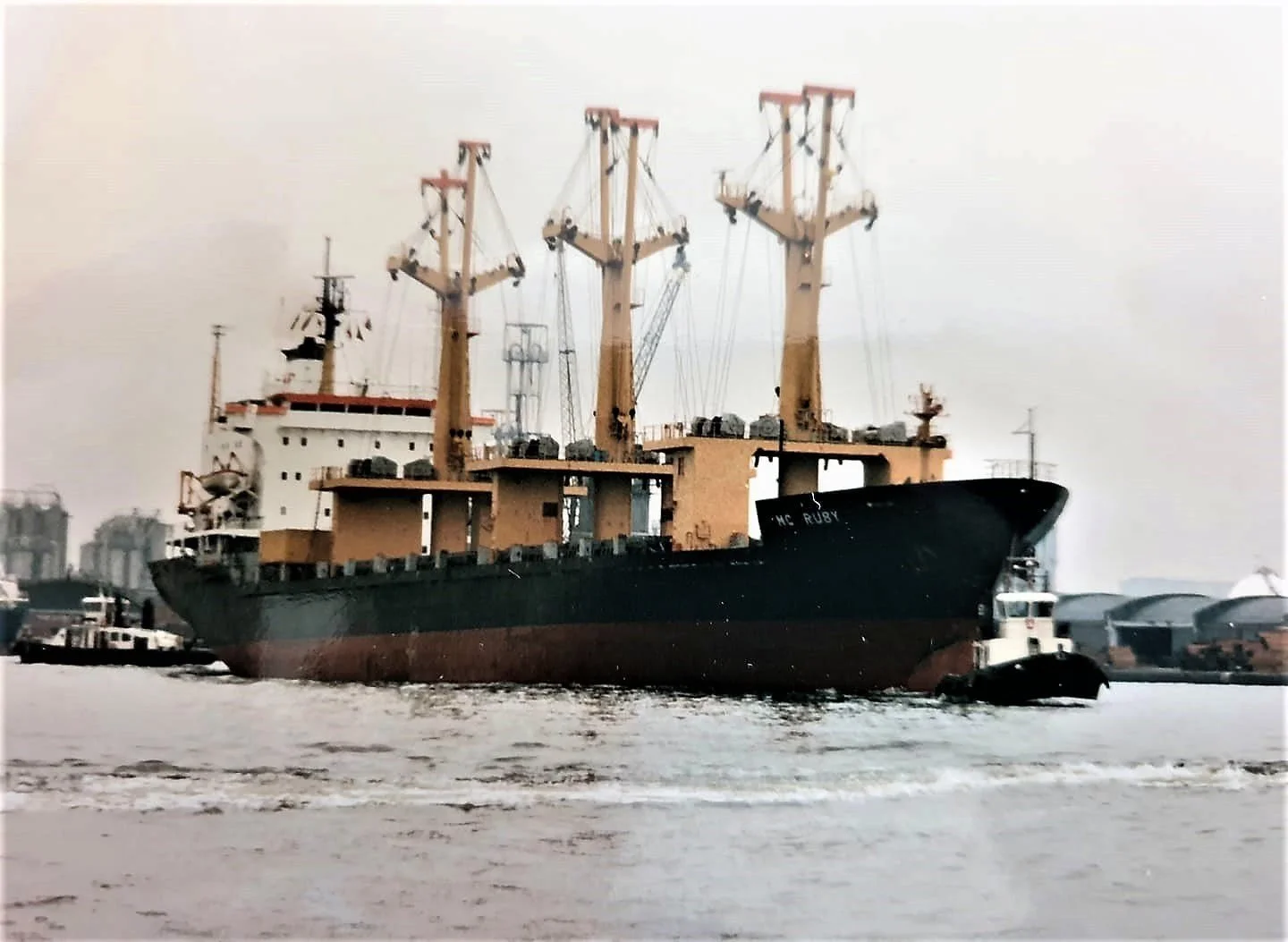
MC Ruby ex- Bamenda Palm (1979)
Courtesy of George Carr
BURUTU PALM – Ran aground off Mombasa
The BURUTU PALM, which had been sold by Palm Line in 1967 eventually becoming the GLOBE STAR, ended her life after running aground along the Nyali Reef off Mombasa on 27th April 1973. She had initially been sold to Greek owners who sold her on to Globe Navigation of Singapore in 1973. At the time of the accident the vessel was carrying 11,000 tons of wheat from Iskenderun in Turkey and she was bound for Karachi in Pakistan. Despite an intensive salvage operation, the vessel broke in half and was abandoned. In November 1973, five personnel involved in a salvage attempt died in No. 3 hold due to gas poisoning while conducting diving operations. The wreck is a now popular recreational scuba diving destination.
The GLOBE STAR stranding was attributed to a navigation error. The ship had approached too close to the harbour entrance prior to picking up a pilot. Having been advised to return to the anchorage, she turned to starboard instead of port and ran aground.
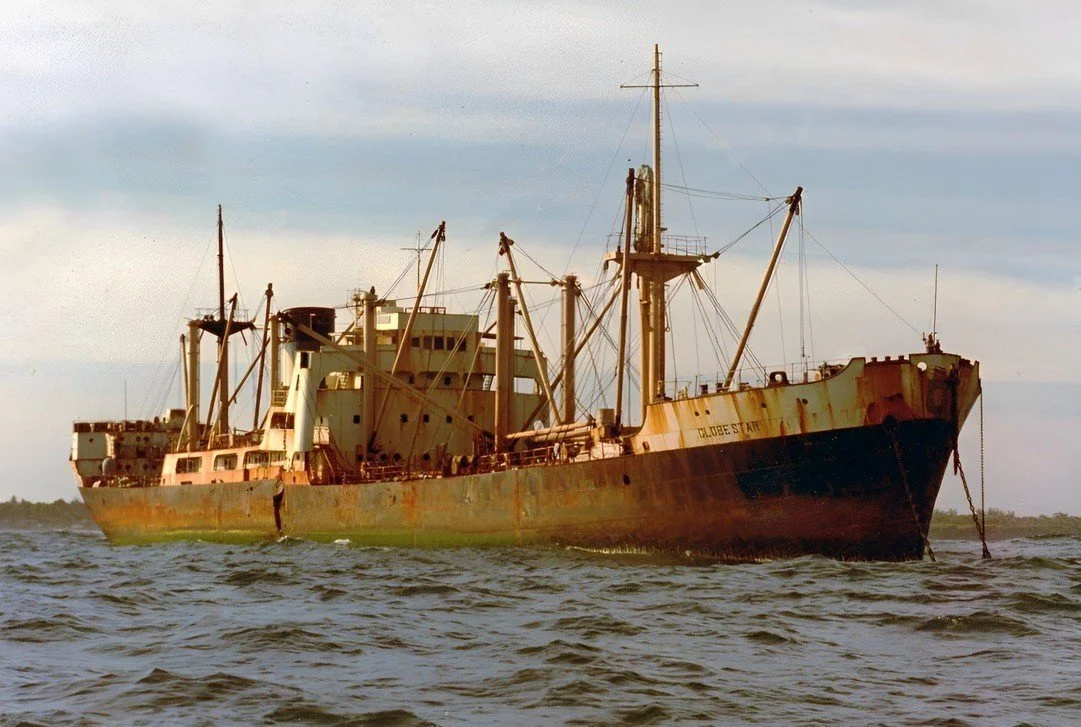
GLOBE STAR - Just before she sank
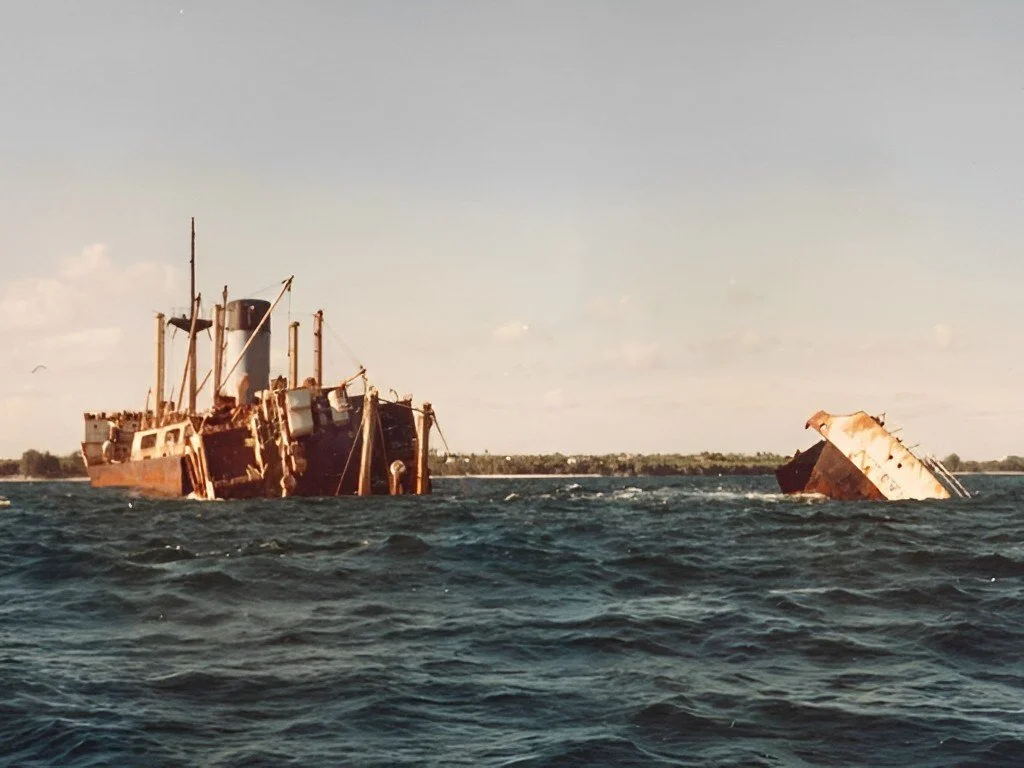
GLOBE STAR - after she sank
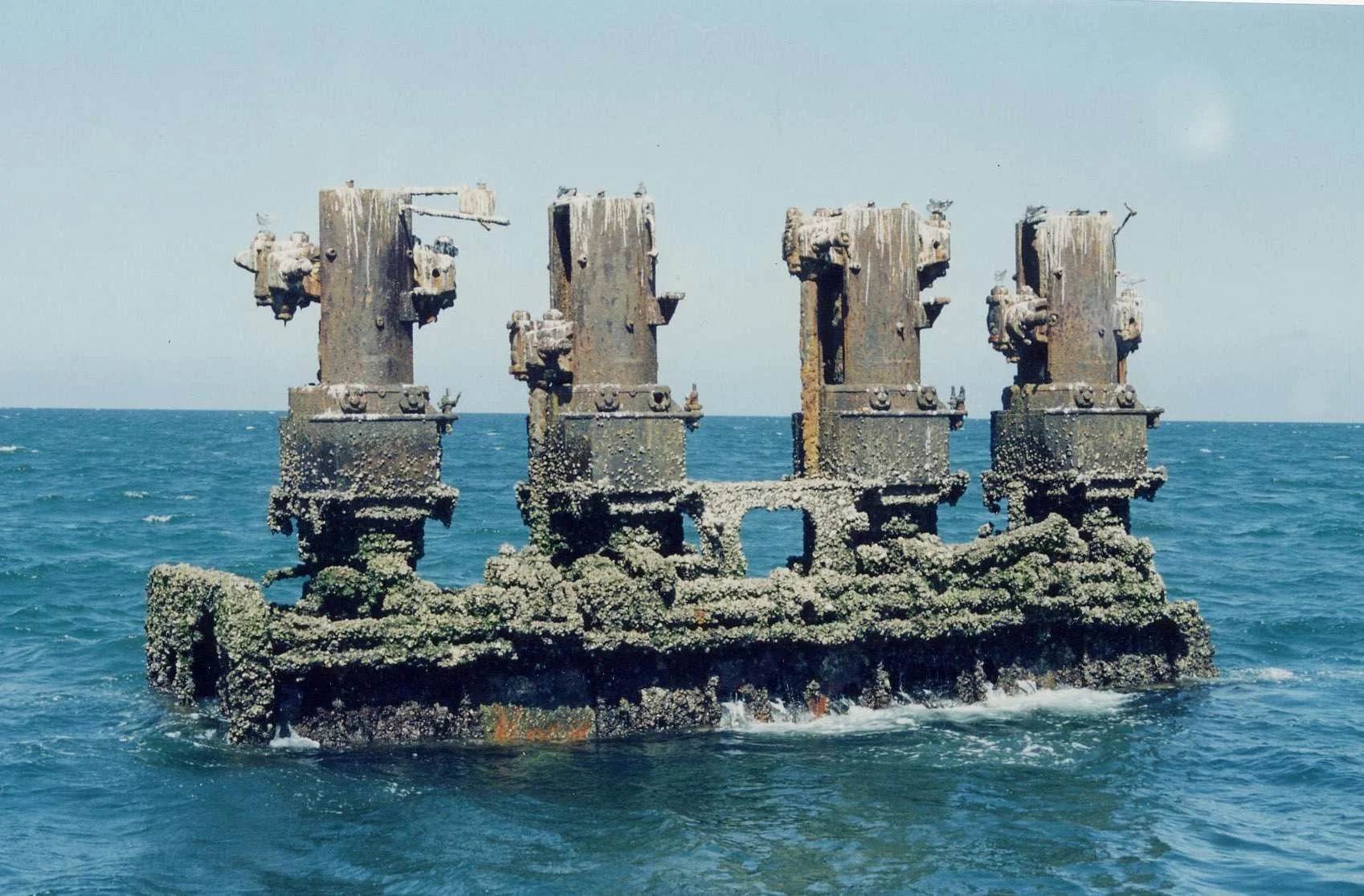
GLOBE STAR - as she remains today
ELMINA PALM – HOEGH AUGVALD COLLISION
A collision occurred off Dakar on the 29th May, 1969, between the Elmina Palm and the originally named 1958 built Uddevalla, then on long term charter to Hoegh Line under the name Hoegh Augvald. At the time of the collision the Elmina Palm was heading into the port and the Hoegh Augvald was leaving.
The vessel had originally sailed from Liverpool in March and had a routine West Coast voyage calling at amongst other ports, Freetown, Port Harcourt and Sapele. It was intending to call into Dakar to take on bunkers.
The collision happened just before midnight as the Elmina Palm’s bridge watch was changing between the Third Officer, Zaw Tun Wain and the Second Officer, Dickie Blomfield. Hughie Bunker was the ship’s Master. The author has not been able to establish exactly why the collision occurred and the results of the inevitable enquiry have not been located.
The ships Writer, John Cook, on his first voyage with Palm Line recalls the incident as follows in a post he placed on the Ship’s Nostalgia site:
We duly sailed out of Liverpool and I really enjoyed being part of the great Palm Line “family” from the off. I loved the wood lined cabins and alleyways. A touch of class. A real “proper” ship. I still think of those older Palm boats in these terms particularly when compared to today’s huge container carrying, off-the-shelf, impersonal “barges”.
I was made really welcome by all but I regret to say that many of their names now elude me after nearly forty years. How I wish I’d kept a copy of all the crew lists. Forty years! Good grief!
The Captain, however, was Hughie Bunker (a “bear” of a gentleman with a huge handlebar moustache) and my Purser was Norman “Mitch” Mitchell, great fun and a great teacher and friend (despite his being a Scouser and an Evertonian to boot!)
I remember Hughie insisted that we had to wear “No 10s” in the bar before and during dinner. How that dress code had changed by the time I left in 1977!
Up and down the Coast with nothing out of the ordinary happening (i.e. we were beaten about 10-0 at football by every team from Freetown to Port Harcourt and back – even if the barman on the Sapele Club team had to play on the wing nearest to the clubhouse so that he could keep nipping back inside to serve drinks!) No, nothing out of the ordinary.
Until we approached Dakar in Senegal for bunkers, that is.
We were coming up to the fairway buoy just before midnight and I was called as Mitch had left it to me on this occasion to quickly deal with the Port Health, Customs, Immigration etc. In those days, the separate Chief Steward did the sweetener “entertaining” and we were only going to be there for a couple of hours with no cargo work. Ha! Little did we know.
Suddenly there was one almighty bang and the ship heeled over about 45 degrees to starboard and then slowly righted herself.
Rushing out on deck, we were all greeted by the sight of the Norwegian ship “Hoegh Augvald” slowly slipping down our port side and facing the same way as us.
I cannot repeat the remarks shouted across to the other ship by the Liverpool deck crew but the mildest was a ”polite” enquiry as to whether the Norwegian captain had obtained his Certificate of Competency from the rear of a cornflakes packet!
We limped into Dakar, now somewhat down by the head, followed (at a distance) by the Norwegian.
Daylight showed us what a lucky escape we had had. As you will see from the photos, the bow was nearly taken off and it was probably only because the logs in No 1 lower hold floated up under the deck plates, that we actually stayed afloat. First trip to sea in the MN, I thought, and they try to drown me! Come back, Panama!
I never did find out the full “official” story of what had actually happened that night (does anybody really know?) but it appeared to us (in the simplest of terms and to the best of my knowledge) that as we were sailing towards Dakar, the “Hoegh Augvald” was sailing out and, for some unknown and unexplained reason, she suddenly and at the last moment turned to port and impaled herself in our bow. She then swung round with our momentum to hit us again poop to poop – so to speak. I may be wrong but that’s how I remember it and the photographic evidence of the shape and angles of the holes seems to bear this out.
Most of the cargo was unloaded (thankfully, no tally in a French port), railway lines were inset and welded horizontally across the VERY large breech and then steel sheets were welded over the top of them as a temporary repair.
We idled the time away partying both ashore and on board with the girls and boys from the British Embassy, the Peace Corps and the VSO, playing rugby, learning Scottish dancing, inventing and learning yet even more extreme and frightening drinking games (Cardinal Puff, Tizz Fuzz Buzz etc), and fishing off Goree Island most days in one of the lifeboats to recover. Apart from handing out the odd few Francs to the crew once a week to spend ashore, there was little else for Mitch and me to do.
Eventually, the cargo was reloaded, we bid our fond farewells, and we finally left for home on what was probably the most careful and slowest ever passage from Senegal to the UK – and the longest trip ever for me (4 months) down the Coast.
Happy Days!
The Elmina Palm was dry-docked and temporary repairs were effected. It then returned to the UK at a reduced speed of 8 knots and permanent repairs were carried out at the Middle Dock’s and Engineering Company in South Shields.
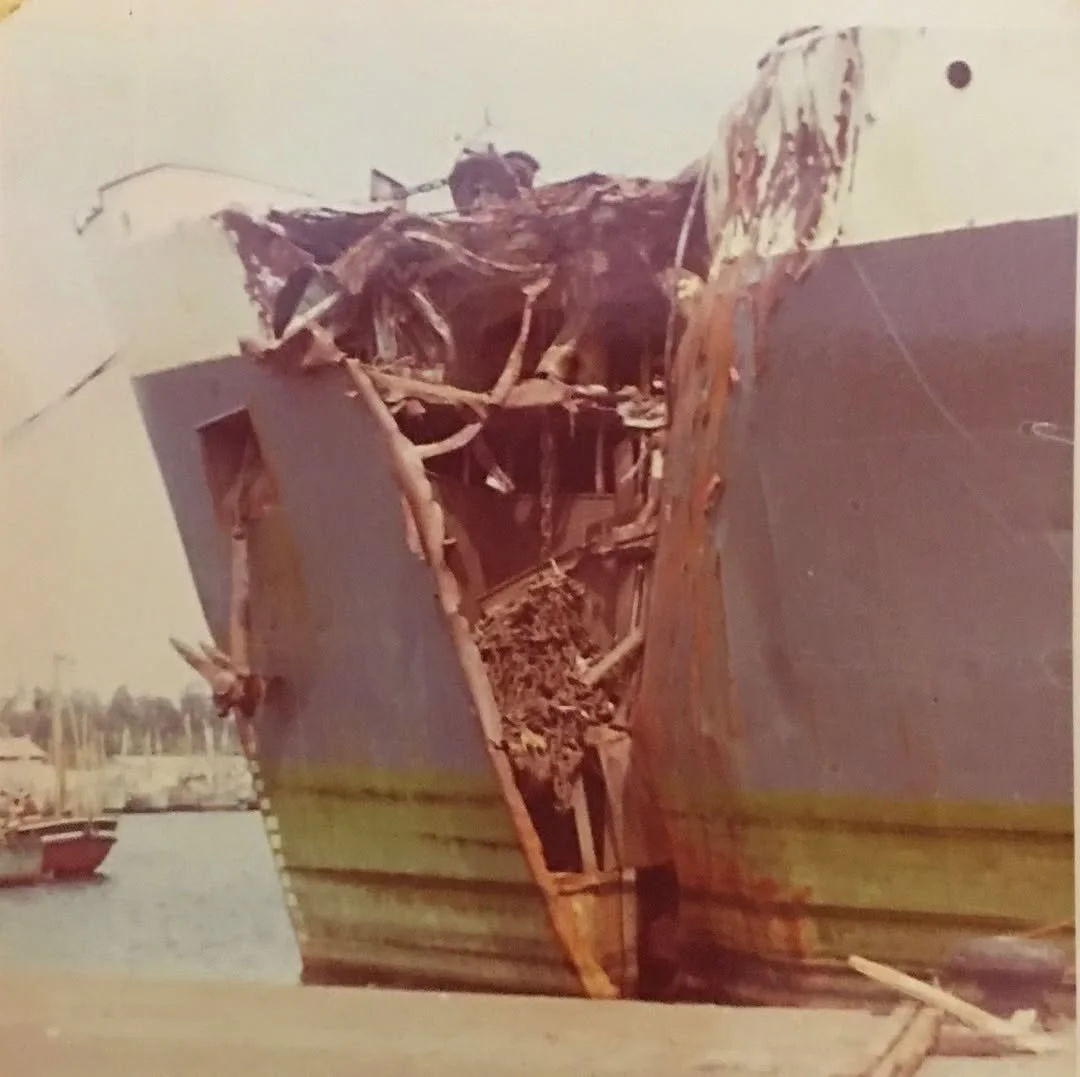
M.V. Elmina Palm berth in Dakar
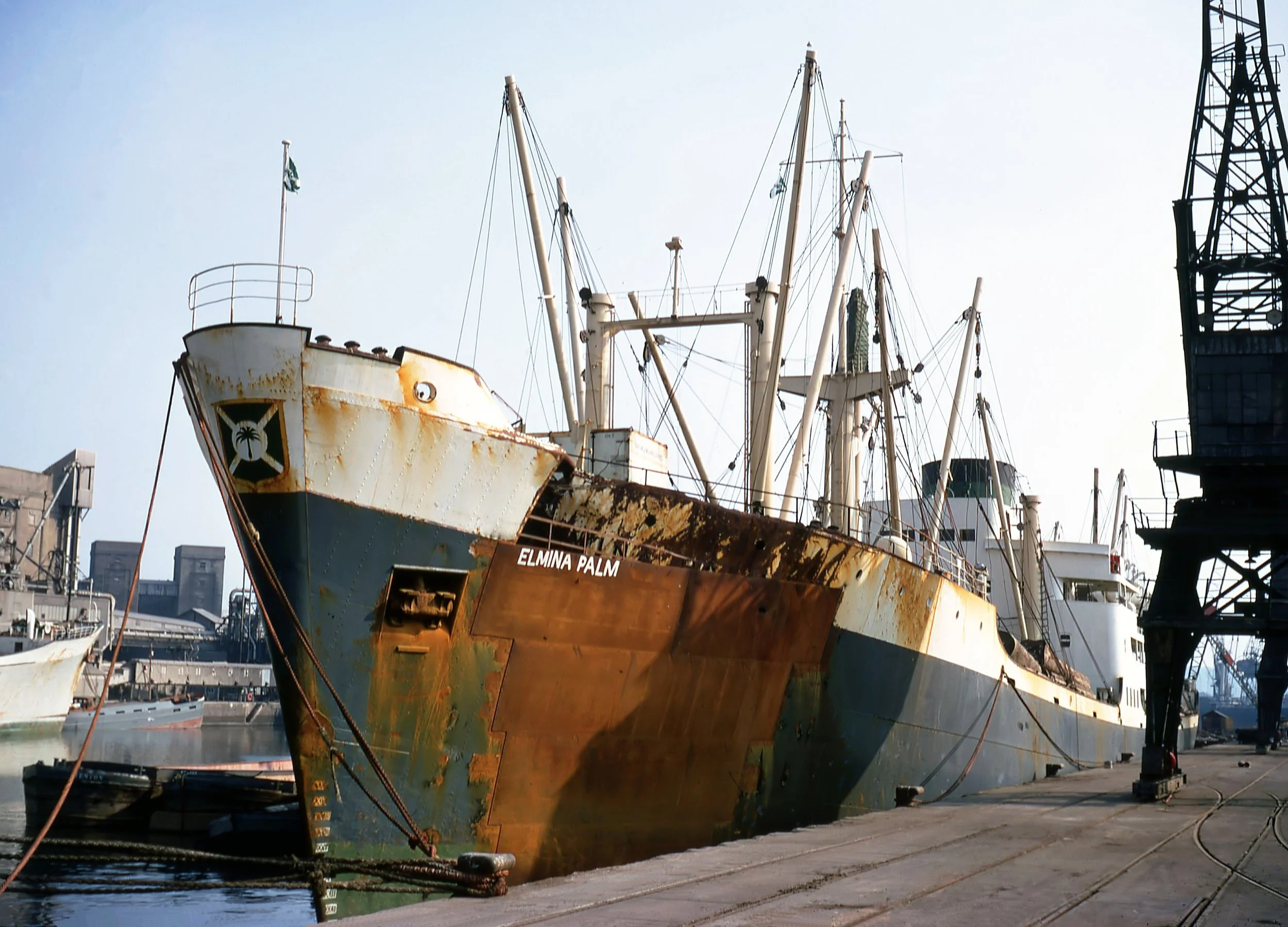
M.V. Elmina Palm - at Avonmouth 14/7/69 © John Wiltshire
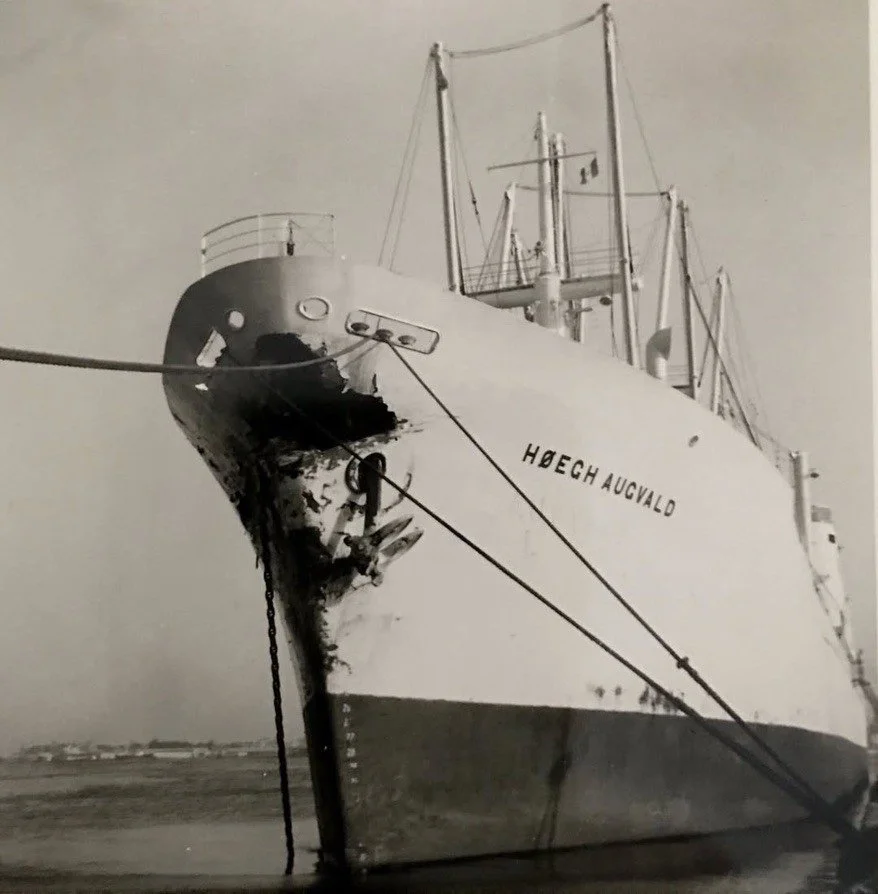
Photos 1 & 3 courtesy of Michael Olsen
ENUGU PALM – Fire while alongside Shed 81 at Hamburg
On 15th July 1970 while the ENUGU PALM was alongside at Shed 81 at Hamburg a very severe fire destroyed the shed but the crew prevented any major damage to the ship by playing hoses on the port side for many hours. The ships damage was limited to paint blistering.
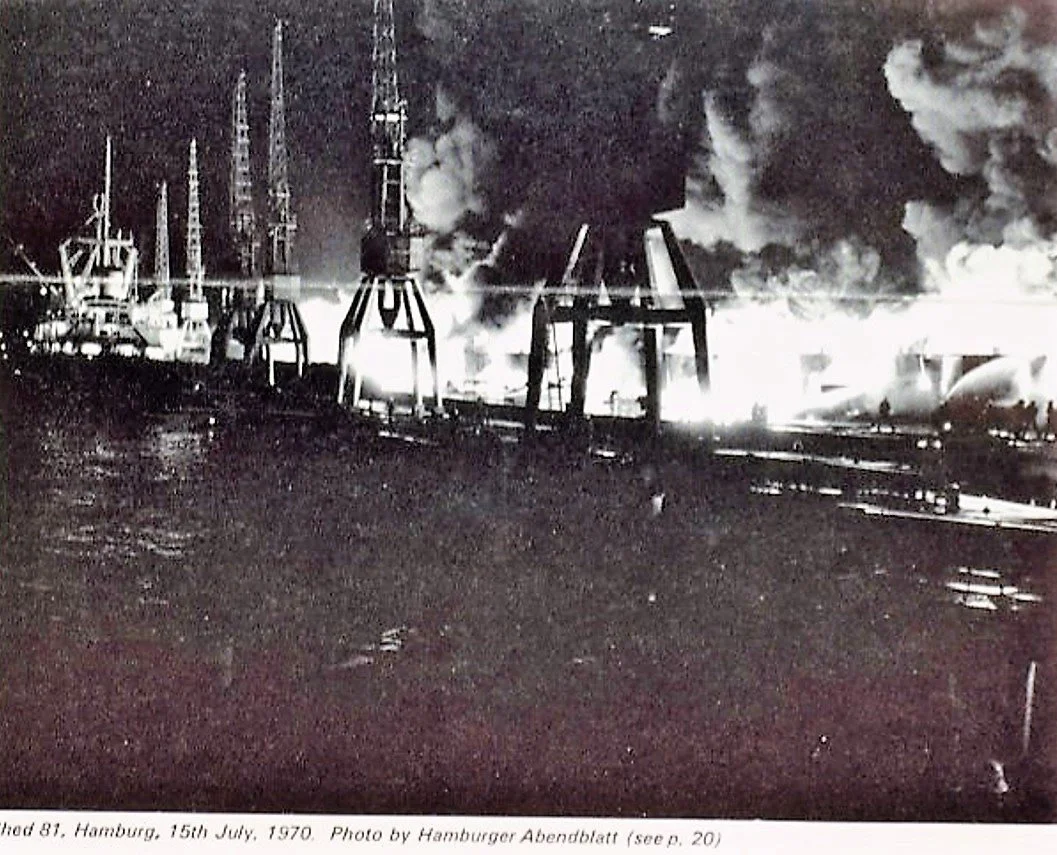
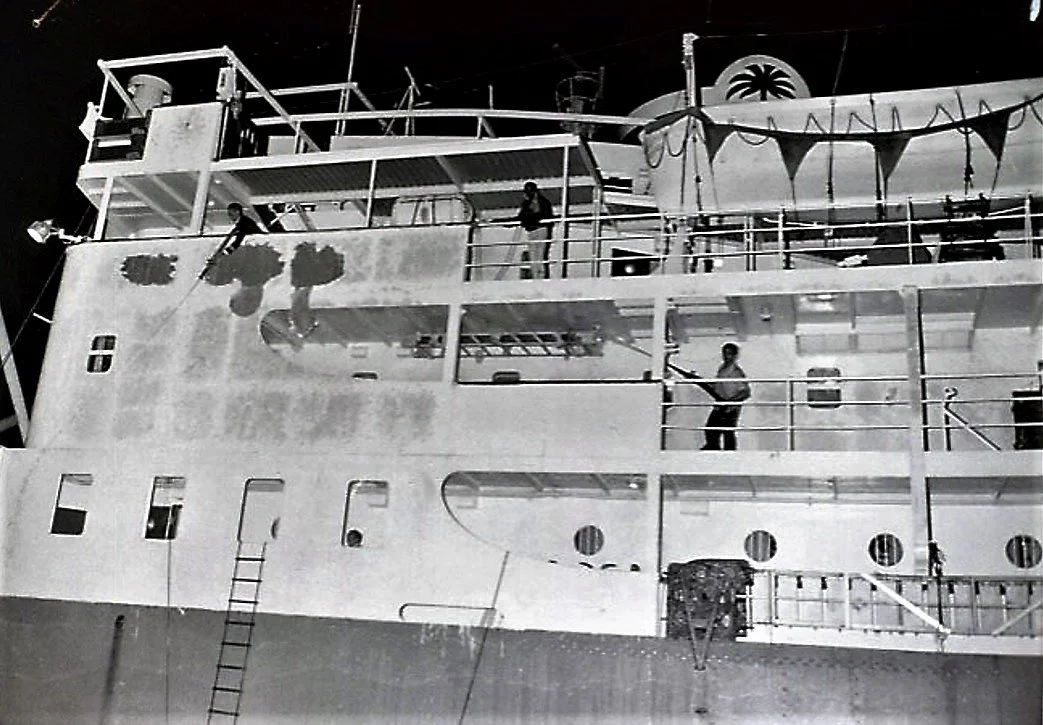
ENUGU PALM: Hosed down to prevent the ship catching fire.
ENUGU PALM -A Most Unfortunate Voyage
Four separate incidents: a double crankcase explosion, a flooded engine room after a burst ballast pipe, the forced repatriation of the Master and the loss of life of the Third Officer on the Enugu Palm during the southbound section of a voyage between Liverpool and Douala must have made this a very difficult six weeks for those on board
The vessel sailed from Liverpool late on the 28th April, 1975. The following afternoon at about two o’clock with the vessel about 20 miles north of Lands End there was a primary and then a secondary main engine crankcase explosion. At the time the Third Engineer, Des Wrest, was on watch. The explosions occurred whilst the vessel was ‘full away’ with the engine running at somewhat reduced full power as a fuel saving measure.
With the engine room full of dense black smoke the engine was eventually stopped. The Chief and Second Engineers, Mike Stevenson and Frank Jenkins, entered the engine room via the lower main deck door and the Fourth Engineer, Seth Holden, via the steering gear and shaft tunnel. However, because of the dense smoke and the possibility of another explosion, it was decided to withdraw temporarily after all the members of the crew had been accounted for.
On re-entering the engine room and after a full check it was found that the main engine forward thrust block bearings had wiped. Three buckets of white metal debris were eventually found in the thrust block crank case. As a result of the friction generated by the wiped bearings, heat had travelled the short distance along the crankshaft into the aft end of the main engine crankcase resulting in the ever-present oil mist igniting. As often happens in these incidents, primary and secondary explosions were the result. The hinged crankcase explosion doors failed to open and shut correctly after the primary explosion as the hinges had been painted too well restricting their ability to close as designed.
As the vessel was now immobilised and, after discussions between the Master, Jimmy Crook and the Chief Engineer, at around six o’clock in the evening it was deemed necessary to call for a tow. The Swansea tug Victoria, which was then berthed in the dock without its crew, was summoned. The crew returned and the tug just made it out of the last lock later that evening. It arrived at the stricken Enugu Palm at six-thirty the following morning and the tow line was attached without any difficulty. As the tug’s mate described it:
“The Victoria made good time in favourable conditions and arrived off the Mumbles around 1900hrs. After boarding a pilot and waiting for the routine traffic movements of any other port, two of our other tugs connected to the Enugu Palm and she was finally berthed on the Dry-dock repair jetty at around midnight.”
It was truly fortunate that no crew member was seriously injured although some did suffer some burns.
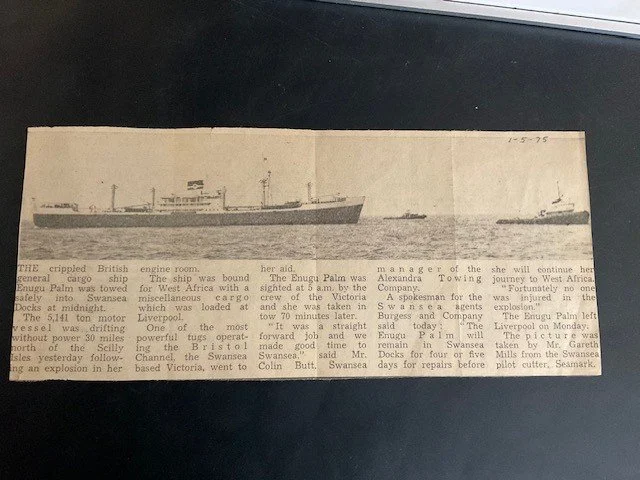
ENUGU PALM under tow by the Swansea based tug VICTORIA
When it came to repairing the thrust pads, it was found that the spares, which were usually bolted to one of the engine room bulkheads, were missing. It was concluded they had been stolen for their scrap value. This delayed the repairs somewhat and it was not until 7th May that the vessel was able to resume its voyage to West Africa.
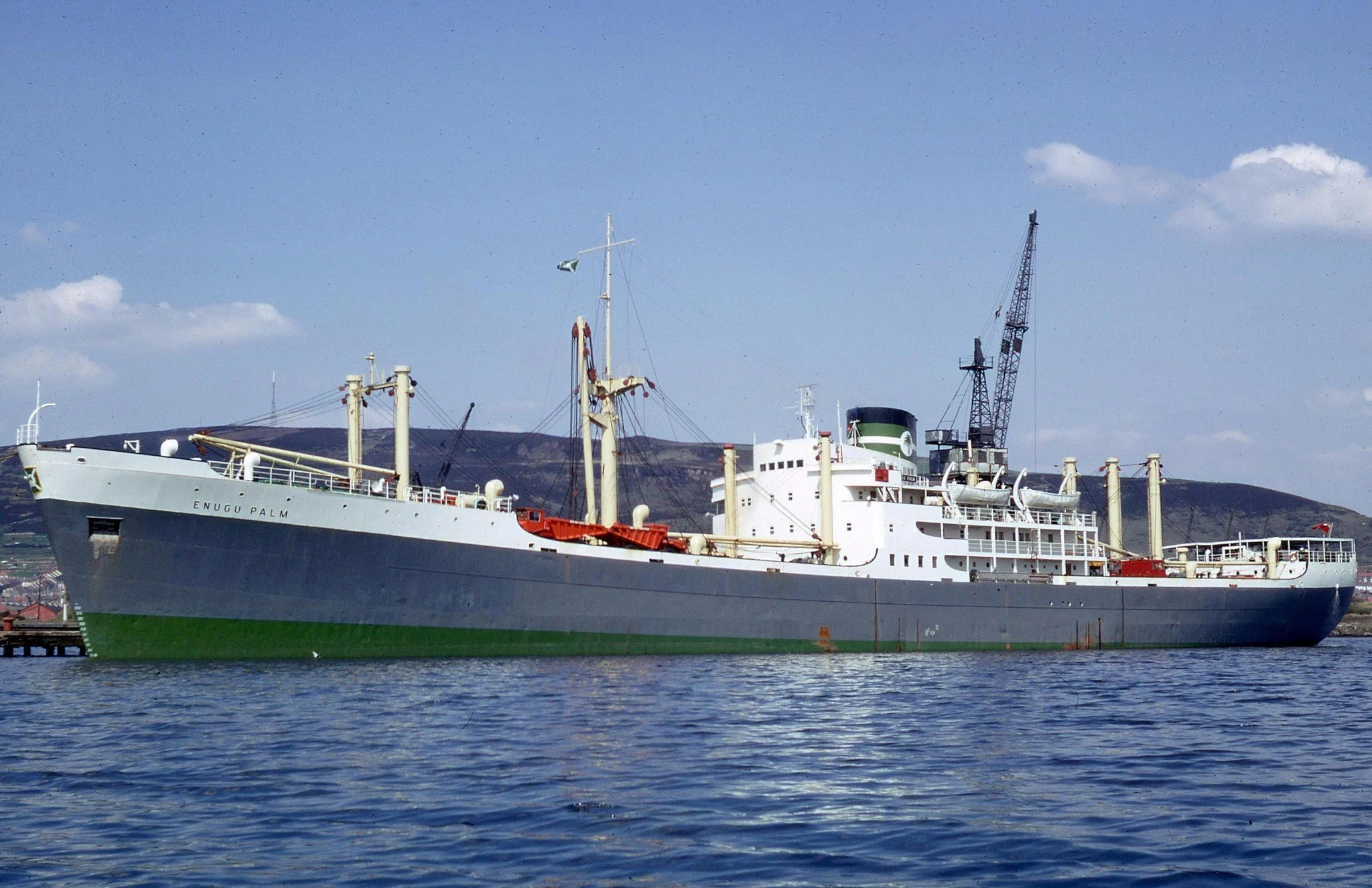
ENUGU PALM at Swansea Docks undergoing engine repairs following the crankcase explosion.
(Courtesy of Chris Howell)
That was not the end of the problems that occurred on what was to become a difficult voyage for those on board. Shortly after sailing from Swansea a large ballast water pipe fractured, and the engine room started to flood. The ship took a severe list to port as a result of the free surface on the engine room tank top. As the water level rose there was real concern it would reach the ship’s main generators resulting in the ship blacking out. As opposed to the old saying, all hands-on deck, it was actually a case of all hands down below with not only the engineers and the Electrician Hughie Dop working to control the pumping and keeping water from reaching the generators, the deck crew and engineers also assisted in constructing a large cement box around the damaged pipe. Control of the leak was eventually established, the water in the engine room was pumped out and the vessel was eventually able to proceed on its way to the West Coast.
The next problem occurred while the vessel was at anchor outside Cotonou. During an evening film show the Master, Jimmy Crook, suffered as minor heart attack and this resulted in him having to be repatriated. No doctor would come out to the ship so the Chief Officer, Bob Ellsmoor, temporarily assumed command and the vessel was manoeuvred into the port to allow Jimmy to be taken to hospital before it returned to the anchorage. A replacement Master, Jan Kopek, was able to join the vessel the following day.
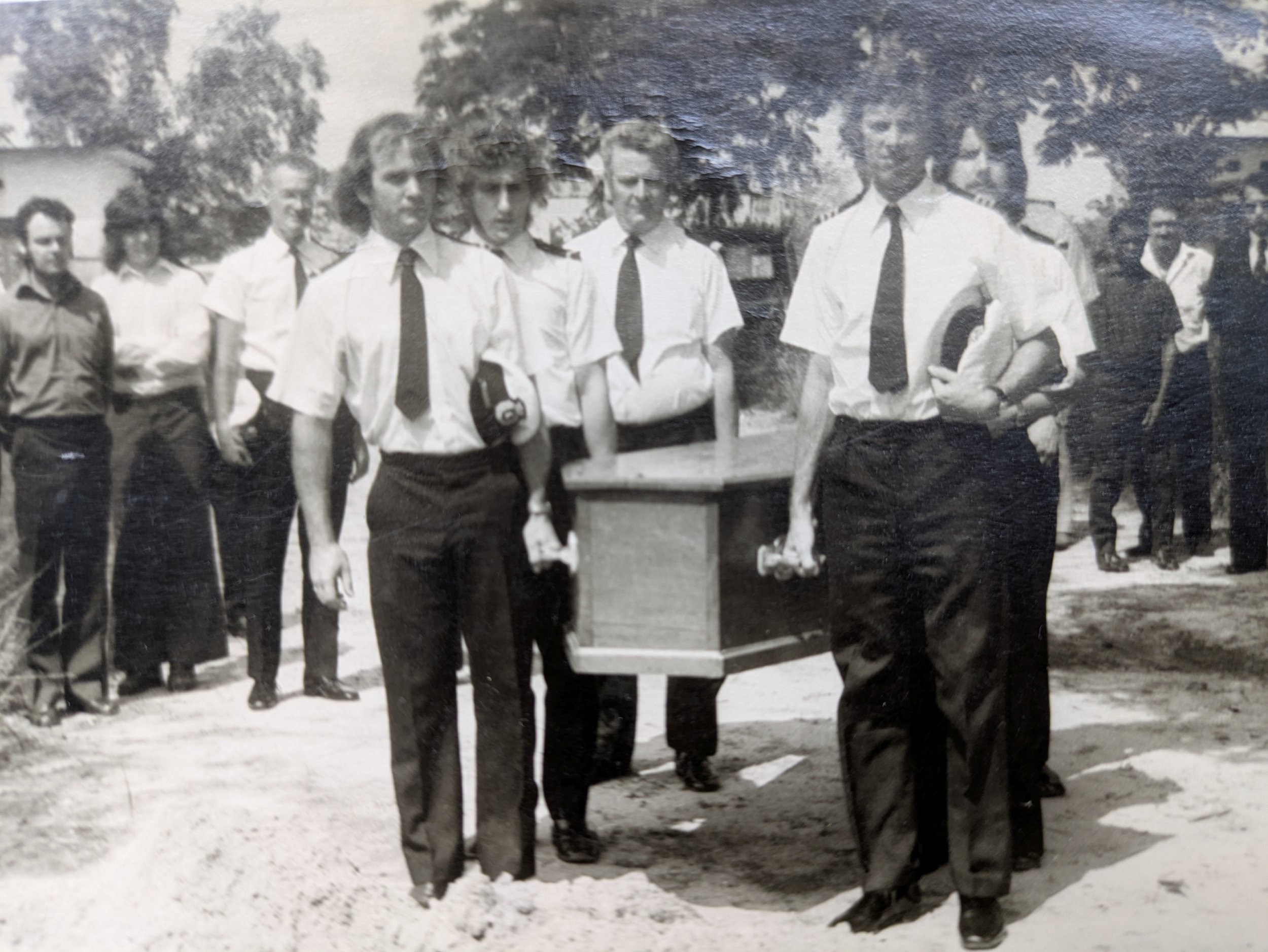
Finally, and most tragically, the vessel’s Second Officer, Ian McLeod, drowned after falling into the dock whilst the vessel was alongside at Douala. He had been visiting an Elder Dempster vessel further along the quay and the accident occurred when he was returning to the ship. As those who know Douala will recall, the ship’s berth there is in an open tidal harbour with fast flowing currents. Unfortunately, his body was not recovered until the next day. At Ian’s parents’ request, he was buried in a small cemetery in Douala with members of the crew bearing the coffin and attending the burial.
There was even a sting in the tail at the end of the voyage. The Junior Engineer on board, Ian White, started to get concerned as a result of the delays during the southbound leg of the voyage as he was due to get married relatively soon after the originally scheduled vessel’s return to Liverpool. Fortunately, the northbound leg of the voyage passed without incident and the vessel arrived back in Liverpool with a couple of days to spare. As usual when one of the company’s ships arrived there, Bernie Grace, the agent, was one of the first on board. He came with the news that the wedding would have to be postponed as the bride had just been rushed into hospital with appendicitis.
KANO PALM – HANNIBAL Collision
After loading cargo for West Africa, the KANO PALM sailed from the port of Hamburg shortly after 4 o’clock in the morning on 6th October 1973. Before entering the engine room at about ten to four the author had a look out on deck and discovered there was a dense fog.
The pilot boarded and the decision was made to sail. The vessel left the berth on the south side of the river and pulled out into the River Elbe opposite Landungsbrücken and St Pauli. It then crawled down the river with the ship’s telegraph rarely changing from long periods of ‘Dead Slow Ahead’. This went on for over four hours. Shortly after Martin Hathaway, the Fourth Engineer, had joined the author in the engine room at eight o’clock the telegraph signal moved to ‘Half Ahead’ and very soon after that to ‘Full Ahead’.
As the author was operating the main engine fuel control lever and the fuel pressure control wheel to increase the engine speed he felt a slight movement. This was somewhat similar to those movements felt in the engine room when a vessel nudged the quay whilst berthing.
Almost immediately, the telegraph went first to ‘Stop’ followed by a double ring emergency ‘Full Astern’. This was soon followed with a ‘Stop’, once again. At the same time, the ship’s General Alarm was rung. The bridge phoned to say the vessel had collided with another ship and there were people shouting in the water.
Within minutes other engineers arrived below and soon everything was under control from the engine room side of things. There were no urgent demands for pumping holds or bilges, so it was assumed the ship was intact.
Next thing, the engine room was informed the motor lifeboat was going to be launched to rescue the people heard shouting in the water. The author was delegated to go in the boat and was he pleased to see Tommy Parkin was there as well. Tommy was a long serving company Bosun whose usual job in those days was to cover the Continental turnrounds. It’s been said many times over the years that Tommy was the finest seaman that Palm Line had ever employed. Sitting in the back of the lifeboat hunched over the engine, what the author wasn’t so pleased to see, or rather not see, was the bow of the lifeboat. The fog was worse than ever. Nevertheless the lifeboat was lowered.
Fortunately, soon after a message was received that the pilot boat had picked up two men in the water. As there didn’t appear to be anyone else to rescue, the lifeboat was slowly raised out of the water and back up to the boat deck.
It took some time for all the facts to emerge. At the time of the accident the KANO PALM was in the River Elbe at Brünsbüttel, adjacent to the entrance to the Kiel Canal. The vessel it had struck was a small 231ton coaster, the HANNIBAL. She had a crew of four and was sailing from Vlissingen to Copenhagen carrying a cargo of bagged sand. She had, without any warning, cut across the KANO PALM’s path in the river as she was looking to enter the canal. The flared bow ran over the mid-ships section of the heavily laden vessel and broke its back. The coaster scraped along the bottom of the KANO PALM before sinking like a stone. At the time of the collision, two of its crew of four were on deck. They were getting the coaster ready for entering the canal locks just about 200 metres away. Miraculously, they were pulled out of the ice-cold water by the pilot boat. Tragically, the two other members of the crew, including the skipper, who were on the bridge at the time of the collision, were not so lucky.
As the sunken HANNIBAL was now a hazard to shipping in the river, she was raised soon after. She was then carried to Cuxhaven where the wreck was sold for scrap. The bodies of the two unfortunate members of the crew were found in the bridge after the ship was raised.
The KANO PALM was downriver from the wreck and was allowed to proceed. The next port was Antwerp where the ship was briefly dry docked to check for damage. Other than a very minor dent in the bow stem just above the waterline and a deep scratch in the paintwork down to the bare steel along the ships bottom to as far as the engine room the ship was unscathed.
OGUTA PALM – Sunk in Mid Atlantic
The 1943 built OGUTA PALM, which had been sold by Palm Line in 1960, sank in mid Atlantic, 320 miles northeast of Funchal on 16th December 1962 when on route from Detroit to Calcutta. Her name at the time was ARISTOTELES and the vessel was sailing under the Greek flag.
Bumps and scrapes happened. There may well be more to find out about, Come back to check and see.